And a Map to Get There

Have you ever gone on vacation, fallen in love with the place, and then moved there?

Posing the question is a college friend of mine, a fellow Massachusetts boy, though from a very different part of the state. Past the age of sixty, he dared to do what most all of us at some time consider but dismiss as unrealistic, too risky, or outright irresponsible.

If that wasn’t enough, he did it again past the age of seventy.

Keep in mind here that the word “vacation” implies long distance. There are dozens of people living in Newburyport originally from the suburbs of Boston who decided to move here after a day trip or a weekend getaway. One woman from Medford told me that the sight of the high school on High Street before she arrived downtown or saw the waterfront was all it took.

This is not about those whose move is but an hour or two away. This is about crossing state lines or national borders, living where people speak with another accent if not another language, where they eat food you never heard of and play music you never heard.

For my friend it was across a continent. If my memory serves, it was about a dozen years ago he visited Portland, Oregon, and decided not to leave.  Except for an occasional vacation, one of which, to San Diego, must have made impression because he moved there about three years ago.

Before Portland, I know that he was in Oakland, a city for which he still has high praise, and that back in the 80s he lived in Vero Beach, Florida, but that’s when I lost track of him.  Whether Oakland and Vero Beach were vacation spots he couldn’t leave or something else caused him to move, I know not.  Nor do I know if he lived elsewhere out west.  I am fairly certain that Somerville and Lowell, Mass., do not qualify as vacation spots.

But twice is more than enough.  This is an adventure that very few dare take once, as we all crave knowing that we have some place to land.

I’ve been tempted to stay in places while vacationing or passing through.  Key West, Florida, during a college spring break comes to mind, but I was already on a five-year plan and rather addicted to writing for the student newspaper.  Plus, it was my Dodge Dart on which four friends were counting to take them back to Massachusetts.

Did I fall in love with Hamburg, Germany?  The architecture was mesmerizing–even more so further north up by the Danish border in the quaint medieval town of Lubeck.  But the foremost temptation was monetary.  I was able to busk in Hamburg’s Ganzemarkt on five of the nine days I was there and returned to America with exactly one dollar more than I had exchanged into Deutschmarks before going over. And that was in the slight chill and intermittent drizzle of November. What would a spring, summer, and early fall be like?

Plus, in 1979, anywhere in Europe offered an escape from the right-wing backlash that most Americans saw coming in the next year’s election.

Still in my twenties at the time, I thought I could make a living in Hamburg and considered not getting on the plane home. Language barrier? Many Germans–and I hear this is true in other European countries–are tri-lingual, and English is always one of the three. I did take German in high school and college, and figured that knowing the basic rules and outlines of grammar and verb declensions would allow me to pick it up in a few months.

But practicality, not to mention claims of family, overruled the temptation of risk.

Unlike my friend, my penchant has been to move to places I’ve never seen, and I can think of two theories that might explain this difference between us:

First is geographic.  My friend hails from a seaside town spread out over a vast expanse of what we call “the upper Cape,” where Cape Cod joins broad shoulder of southeast Massachusetts.  Wareham includes inlets of the Atlantic with names such as Buzzards Bay while also boasting pine forests and cranberry bogs.

While he grew up with plenty of sights to fall in love with, Yours Unruly was born and raised 25 miles inland in Lawrence, a burned-out, brick mill town along a river that served quite frankly as an industrial sewer for several such towns up near our state’s New Hampshire border.  While my friend thrived in places that invite love at first sight, I was wired to get out, ASAP, just give me a place to land and a map to get there.

For an idea of Wareham in the 50s and 60s, you could read Thoreau’s essay on Cape Cod. For Lawrence, you might as well read Dickens’ Hard Times.

The other theory attributes the difference to age.  While he may have done it decades ago, my friend’s last two moves have been made past the age of 60, gambling on finding ways to get by.  All of my escapist moves were in my twenties with some guarantee of income awaiting me.

Landed my first newspaper job after answering a classified ad in Editor & Publisher magazine.  That sent me to Fort Kent at the very top of the state of Maine, 200 miles north of Bar Harbor, or 300 by car to avoid the Allagash, the farthest I’d ever gone in that general direction. A small, yet unassuming college town on the elegant St. John River, Fort Kent was a most comfortable place to live despite my being there just three months in the dead of its five-month winter. So I saw the town and the lovely valley always covered in white, the river with ice.

When that fell through–not the ice, but the job–I aimed for a commune outside Machias, Maine, another place I’d never seen along the coast and also close to New Brunswick’s border. But that was briefly to buy time, mostly to again scour classifieds in Editor & Publisher at the state university library for another gig. How about a graduate assistantship at South Dakota State University? Why not? I was on a bus to Brookings, S.D., just ten months after the move to Fort Kent.

South Dakota unseen? Everything west of Cleveland was new to me: the land turning flat, the endless cornfields, the roads all perfectly straight, parallel and perpendicular, the industrial mess of Gary, Indiana, and then the jaw-dropping, knee-wobbling beauty of the Mississippi River bluffs. Brookings, another small college town, has all its streets lined by trees, an ocean of birdsong at dawn and dusk. I made friends quickly, no doubt because I was a curiosity object who couldn’t pronounce the letter R and made the letter A sound funny. Except for foreign students, I was the only one with black hair and a (relatively) dark complexion, something that a young fellow in that part of the country can get a lot of mileage out of.

Luckily, I was quick to find a trailer to rent on the very western edge of town, overlooking alfalfa fields where mares and their newborn colts sometimes played. So it was easy to settle it. In fact, I left Brookings twice only to move back both times. First time was a hitchhike to Seattle thinking I’d get some job on a ferry to Alaska or a cargo ship to Japan.

Halfway there, however, I caught a ride from a fellow my age from Missouri who said his brother was working some oilfield in the Yukon and the company was hiring anyone who could get there. The deal was a few months of no days off and nothing else to do, and then more money than I’d make in a year anywhere else and all the time I wanted to spend it wherever I wanted to go. I was game, but Canadian customs were not. The agent reasoned that the letter applied only to the driver, and this guy with the SDSU ID and expired Massachusetts drivers license appeared to have no credible connection to the guy with Missouri IDs and “Show Me” plates on his car. As the two of us debated him, at some point I let the word “hitchhiker” slip. With a roll of his eyes, my new friend turned into my ex-friend and continued north while I stuck out my thumb to the west.

So there’s an attempt at a sight unseen that stayed unseen. So, too, would my plans for Alaska or Japan, or Hawaii or China, or wherever a boat out of Seattle might go. Card-carrying Merchant Marines were lined up on the docks of Elliot Bay waiting for jobs to open up. A busking duo awaiting a ferry to Alaska told me they left jobs at a state hosital in northern California, Eureka if I recall, and I was sure to land one, possibly as a music therapist.

Before sundown, I was on I-5 south with a cardboard sign that read CALIF. By nightfall I had a ride with a fellow my age, a guitarist, who told me that Salem, Oregon, was the place I wanted to be after I played a tune or two and told him of jam sessions back in Brookings. He could give me a place to stay a few days, knew for sure that the YMCA right downtown had cheap rooms, and–most convincing of all–his wife worked at a day care center where they were desperate to find and hire a male would would work (i.e. throw a football around outdoors) with the older boys.

Salem O, lush with grass and shrubs, plants and flowers, trees of pine and cherry, and the ever-burbling Willamette (rhymes with “Don’t dam it!”) River running through it, became home for a few months before I thought I’d better get back to SDSU and finish what I started. Coincidentally, that very week, as if sent by a higher power if not the college itself, an Dakota friend pulled up in an 18-wheeler thinking we’d have a couple beers. In no more time than it would have taken us to settle in at Jokers Wild next door, we were climbing into his cab, throwing my duffle bag and typewriter into its back compartment. We were on our way to South Dakota via Kansas City–a city I might yet move to had I a job offer.

I’d have gladly stayed in Brookings the next two years to finish grad school, but after one year, I missed a deadline for a student loan. To bail myself out of that mess, I applied to VISTA, Volunteers in Service to America, or “the domestic Peace Corps” born in the Kennedy-Johnson years that was wiped out by Ronald Reagan as soon as he took office after campaigning all through 1980 on “a spirit of volunteerism in this great country.”

Through the 70s, VISTA had a huge commitment to the Native American tribes in the Dakotas where one dozen reservations spread across the two states. After a few months busking in Denver, a place I had seen more than once, I was quickly placed with the United Tribes of North Dakota, not to any of the reservations, but to an educational center they had in Bismarck. Another move sight unseen.

Like Salem O, Bismarck is state capital which always offers intrigue, and there was plenty of it in the bar on the ground floor of the Patterson Hotel in the heart of downtown. I quickly made friends with reporters for the Bismarck Tribune which let me in on some of it–to them, a grant-writer for a state-wide organization was a “source,” after all. Atop bluffs overlooking the Missouri River, Bismarck is a pleasant place to live apart from its unforgiving, nostril-freezing winters that last a solid five months.

Eventually, I’d return to Brookings–my third move there–to finish grad school, and then, like the Prodigal Son, back to Massachusetts, washing ashore on Plum Island where I’ve stayed put these past 41 years. You might think that the two settings, the Prairie and the Coast, could not be more different, but I chose Plum Island over, say, Newburyport or Salem because here I overlook a marsh covered by grass that sways in the wind much like the alfalfa fields outside my perch in the Easy Livin’ Trailer Court–not to mention sunsets on a distant horizon.

Might have been sight unseen when I went there, but I see it everyday now.

Have I ever gone on vacation, fallen in love with the place, and then moved there?

No, but I’ve moved to and then fallen in love with unknown places that I’ve remembered all my life here on an island where many come to take vacations.

-30-

Ottawa, Ontario, is another place I passed through (1976 I think) where I’d gladly have stayed had I a dependable gig–and to where I’d now gladly return for other reasons. Showing this photo because I was in my mid-20s, the decade when I made all of the moves described in the narrative–and because it includes the late and seriously-missed John Yammerino of Sisseton, South Dakota, the friend who showed up in Salem, Oregon, in the 18-wheeler to return me to SD. This trip was a visit to New England with yet another South Dakotan, Michael Boer, who took the photo.
At Salem State College circa 1973 with Buddy Cushman, native of Wareham, Mass. and former resident of Encinitas, California; Portland, Oregon; Oakland, California; Vero Beach, Florida; Lowell and Somerville, Massachusetts; and who knows where else? Now living in San Diego and asking questions that have never-ending answers. Photo by Steve Salvo.

My life in Fort Kent and Bismarck is described in two blogs:

Life in Oregon is a chapter in my book, Pay the Piper!, titled “In Need of No Microphone.” Scenes from South Dakota appear in several early chapters in Piper.

My ’68 Ford Falcon and I aside the Missouri River, Standing Rock Reservation, not far south of Bismarck, North Dakota, 1979. Photo by Michael Boer.

A Diamond’s Dark Dance

Any documentary of a career that peaked in 1960s America is bound to include footage of the Civil Rights and Anti-war movements, if simply as background for subjects not directly involved.

Timely? When early-60s Chevys and Fords flying Confederate flags rush past demonstrators, try to not look for Trump and MAGA stickers on their back bumpers.

As if to defy that, I Am a Noise opens with a vocal coach on piano making a 79-year-old Joan Baez reach for notes.  She gets most of them, and so does her white lab, snout pointed upward, much to the delight of the movie audience.

Back in the day when many in the audience were her fans, Baez was deeply involved in politics, and so she appears in much of the archival footage of I Am a Noise.   We see her marching alongside Martin Luther King and James Baldwin, getting arrested and sitting in with David Harris, a leading organizer of draft resistance, and eventually her husband.

In what may be the films’s most delightful moment, she dances barefoot beside a broadly smiling Harry Belafonte who claps to keep time while marching on Washington.

But the film, like time, moves on, and we find Baez thirty years later at Democratic fundraisers laughing it up with luminaries such as the Clintons and the ageless Belafonte.

Belafonte, as far as I can tell, may have never stopped smiling, may be smiling down upon us yet, but Baez grew up with demons that had her in therapy when she was still in high school, and that she never completely shook.  She kept a daily journal that co-directors Miri Navasky, Maeve O’Boyle, and Karen O’Conner use sparingly yet so precisely that a single sentence is worth a full picture.

One gives us the film’s title when young Joan writes that she is not a saint, “I Am a Noise.”

After the huge success of Diamonds and Rust in 1975, generally acknowledged as among the finest albums of the era, Baez sank into quaaludes.  Two years later, her Blowing Away bombed, not at all helped when she sported an aviator’s suit with skullcap and goggles for what she now laughingly calls, “the worst album cover of all time.”

The first three-quarters of I Am a Noise offer a fascinating and enlightening look into the life, music, a politics of a singer/activists that many women my age wanted to be.  (Carole King & Janis Joplin were others.)  This includes her relationship with the enigmatic, impish Bob Dylan who many young men wanted to be before John & Paul hit the scene.

Painful, yes, but as a septuagenarian speaking to the camera, Baez interrupts herself to laugh and wave, “Hi, Bob!”

On a personal note, I wonder how many of my generation felt a twinge of lament when she says in a voiceover during footage of an anti-war demonstration, that after the war in Vietnam ended, activists didn’t know what to  do with themselves, feeling lost and disoriented.

That line helps describe my life as much as the quote from Gabriel Garcia Marquez which starts the film describes hers:  “Everyone leads three lives: the public, the private, and the secret.”

The last quarter of I Am a Noise turns dark.  Fans my age will recall the duet of Joan’s sister Mimi and her husband Richard Farina that seemed to take the folk music world by storm.  That tragedy is but a part of it, and I’ll leave the rest to the film–except to say that, if you are surprised by an opening credit listing Patti Smith as the film’s producer, you won’t be surprised when it’s over.

Dark as it may be, light persists with a scene of Baez, well into her seventies strolling in Paris when she happens into a square where a dozen drummers have drawn a crowd.  Baez cuts dance moves as agile as the twenty-year-old alongside Harry Belafonte.

In the last scene, she’s dancing in a field outside her California retreat, slowed down a bit, with her white lab her only company, the same dog who sang with her aside the piano.  She is serene, eyes closed; the dog is silent, head down. Her voiceover describes “one day” when she realized that she “was no longer the person I was.”

Talk about hitting close to home! Talk about my generation. Then again, Baez has made at least one appearance on stage with now touring Taylor Swift.

-30-

Following her farewell tour in 2018, Joan Baez has devoted much of her time to painting. Here she is with Black is the Color, an acrylic self-portrait. Other portraits include Nelson Mandela, Patti Smith, Bob Dylan, Kamala Harris, and Ruth Bader Ginsberg. Photo by Marina Chavez.
https://www.goodnewsnetwork.org/joan-baez-turns-80-with-new-art-exhibit-live-streamed/

A Draft of Going Daft

Settling in here at Plum Island Coffee in Market Square, Newburyport, with a black Brazilian roast in a cup the size of a sink to work on one of two draft, and somewhat daft memoirs–“Autopsy of a Joke” and “Sight Unseen”–when I hear the proprietor ask:

“Is that your wallet?”

I assume he’s asking a customer at the counter, but as a joke, I’m about to call over my shoulder, “No, Bruce, not mine!” As if it’s part of the act, I reflexively tap my back pocket, and am immediately alarmed and on my feet. Three steps later, I recognize the item right where I had pointlessly left it.

“Oh, thank you, thank you!”

“Thank him,” Bruce points to a customer, “He noticed it.”

I turn, look up into the face of a tall millenial, and repeat a few more thank yous. He smiles and nods. Only later do I realize that he did not use the interminable auto-response, “No problem,” for which I am even more grateful. Certainly would have been a huge problem for me had he been an opportunist and stealthfully pocketed it. Of course, that’s precisely why I would not have noticed had he said it.

Maybe he noticed that I was already turning back toward Bruce, a fellow who moves in some of the same local circles as I. Putting an index finger over my lips: “This didn’t happen, Bruce. You saw nothing.”

Always easy to gain agreement when the person you’re counting on owes you the identical favor: “No idea what you’re talking about, Jack. All is good.”

Sitting back down, I have no mind for daft drafts, but am starting to feel a draft of going daft. I walked in here with a front pocket stuffed with a roll of one-dollar bills gained in tips while piping endless variations of “Greensleeves” and “Hole in the Wall” at a Renaissance festival to buy a single, if enormous, cup of coffee. Why would I reach for my wallet?

Out of habit? Fair enough, but then why did I not put it back when I recalled and paid with the wad of ones?

Blame it on the wad of ones! My weekends this time of year are always at the renfaire, and when I awake on Sunday morning in a friend’s condo in Halifax, I just jump in my clothes, then my car and drive straight to the caffeine served by Kiskadee Coffee in Plymouth center.

Often I’m there when no one else is, as early as 7:30 to catch up on any correspondence sent me in the last 24 hours when I’ve been off the grid.  No WiFi at the condo, and no way I’m bringing any device into Monponsett Inn where I wolf down a post-faire feast on Saturday nights while enjoying playoff baseball and college football on the TV monitors. The tab and tip are covered entirely in ones.

Cellphone?  Ha!  You don’t know me, but if you’re paying attention, you do know that I park my car in front of Kiskadee when no one else is is sight.  Nor are any cars, so I go right to the last spot before the intersection where I’m guaranteed to be clear for takeoff.

NPR is airing what it calls a “driveway moment.” Despite my inability to recall the report now, it’s worth the 40-or-so foot walk back to Kiskadee. I keep the engine going but put the car in neutral because the brake is easier to press than the clutch.

Automatic transmission?  Ha!  You really don”t know me, but by now you can guess that when I kill the engine, pull the key, and leave the car, I neglect to either put it back in gear or apply the emergency brake.  Only now does it occur to me that I should think of it as auto manufacturers and DOTs want us to think it: a parking brake.

In my own defense, I might say that this section of Court St. in Plymouth appears to be level.  And it must be very close because, luckily for me, the trunk of my Versa takes at least a half hour to appear outside Kiskadee’s door, its rear bumper resting harmlessly against the front bumper of a car parked here not long after my arrival.

As the saying goes, no harm no foul, so I simply drive off.  But I can report that my parking brake has gained more use these past six weeks that it has in the six years I’ve owned the car, possibly in the 40-plus years I’ve owned stick-shifts.

As we often hear, short-term memory is often a stranger to advancing age. Can’t keep one and continue the other, and the other will be my choice as long as I have a choice.

Better move on to “Autopsy of a Joke” (but not the joker) or “Sight Unseen” (but sight nonetheless), except that I can’t recall what I was ready to say about either of them.

Worse yet, the Brazilian is gone.

-30-

An A-sharp on a sopranino recorder outside the front gate of King Richard’s Faire, 2023. Photo by Paul Shaughnessy.

When Am I This Time?

We often hear people ask or wonder where they are, both literally and metaphorically.  If they refer to a personal crisis, we might say they need to figure out who they are.

Not me.  My challenge is to figure out when I am.

Tis the month of October when, all through each week, I spend weekends in 1510, Mondays and Tuesdays in 1692, then Wednesdays at a cinema projecting films that, this lunar cycle, are set in 1967 and 1983. As if that’s getting too close to the present, yesterday, a Thursday, I registered at the first possible moment to be part of the annual marathon reading of a novel written in 1851.

I’m not just “living in the past,” as the saying goes, I’m bouncing around in it.

In his 1968 counter-culture classic, Slaughterhouse Five, Kurt Vonnegut coined the expression, “unstuck in time.” Reaching old age in the 1960s, mild-mannered protagonist Billy Pilgrim (a name that itself darts back three centuries) alternately returns to Dresden during WWII and launches into an interplanetary future.*

But Pilgrim had no control of when he’d leave the present or in which direction he would go.  For me, the schedule is set, and the result more resembles a story Vonnegut wrote eight years earlier.

Set on Cape Cod, it’s about a community theater troupe joined by an impossibly shy man and a young travelling rep of a computer company spending the summer in the small town. She’s cautiously open to something to occupy her evenings. May have been the most popular reading assignment I ever gave my college classes–along with others in Vonnegut’s Welcome to the Monkey House collection. But for now let’s just say that, however reluctantly at first, they eventually soar to life as soon as a character name answers the question they ask. It’s the story’s title:

“Who Am I This Time?”

This month, I might ask that myself, as my name keeps changing depending on when I am.  At the Renaissance faire, I am Hamm Lynn, a nod to my ancestor in the colorful coat who kidnapped an estimated 130 children in an Alpine town in 1284.  For the reenactment of a Salem Witch trial, I may be villager John Louder, farmer John Bly, or Rev. John Hale.  (At least I can’t screw up my first name.) Considering what I do at the Screening Room, I am both Jack in the Booth and Jack the Ripper.  And if I am once again selected for the New Bedford Whaling Museum’s annual reading of Moby-Dick in January, call me Ishmael–even if I may be quoting Ahab, interpreting Queequeg, or drinking Starbuck’s.

Still, as you likely noted, who I am on any given day depends on when I am. You may also have noticed that two weekdays are unaccounted for and should serve as 48 hours when I can figure it out.

Cut! As a projectionist, I’m necessarily on a schedule requiring that films begin their runs on Fridays, always ending them on Thursdays. At a small arts cinema such as the Screening Room, it’s often a single week run and rarely ever goes three. As a result, Thursday for me feels like Friday, while Friday, since it is mostly free, feels like a weekend. The confusion is compounded whenever I hear someone say, “Thank God it’s Friday,” because what they describe sounds to me like Thursday.

So even when I know I’m back–forward?– in 2023, I have trouble keeping days straight. But I am unconcerned about days. Once we get past Halloween, I’ll be back to a two-day work week, neither of which will require a change of name, a change of garb, or any attempts at Merry Olde English or Colonial speech.

By that time, I’ll be like everyone else wondering where I am, at times who I am, and if things really go south, why I am.

Roll camera!

-30-

*Two years ago, Unstuck in Time was the title of a documentary on Vonnegut that played at the Screening Room:

Stepping Backwards

Christopher Walken and Susan Sarandon as Harry and Helene rehearsing Stanley and Stella in A Streetcar Named Desire, a scene in a 1982 one-hour television adaptation of Kurt Vonnegut’s “Who Am I Today?”
https://www.imdb.com/title/tt0083325/
As Hamm Lynn in 1510. Photo by Yvette Yvettes.

To Quench Our Thirst

In a city that prides itself on support for the arts, especially for local artists, many might jump at the chance to attend a world premiere play penned by a local guitarist long-known for his flamenco, Spanish, and classical performances in downtown Newburyport.

Fuente Grande, based on the persecution  of Spanish poet Frederico Garcia Lorca and steeped in the music played around town all these years by John Tavano, plays just twice at the Firehouse this weekend:  Saturday at 8:00 pm, Sunday at 3:00 pm.

The title translates into English as “big fountain,” a reference to Lorca’s prominence as a poet who “awakened a nation.” As the Firehouse also tells us:

The feel is 1936 Granada, Spain, on the brink of civil war. It was a time of great social upheaval and people were being intimidated and, in Lorca’s case, murdered.

Produced by The Actors Studio, this is dual effort that is local on both sides.  The director has staged all kinds of plays for young and old at Newburyport venues as diverse as the Firehouse and Maudsley Park for some forty years and counting.  If that’s not enough, Rhina Espaillat and Alfred Nicol, two local poets who seem to share the mantle of Newburyport laureate, will be there to add their voices.

Guitarist-now-playwright Tavano took his first dramatic effort to Actors Studio director Marc Clopton as soon as he thought it ready to be fashioned by someone who actually knew what he was doing.  Turns out Tavano was closer than he thought, as Clopton’s changes were minimal.

Or so I hear.  In the interest of full disclosure, I count myself a good friend of Tavano, the only wind-musician in his weekly coffee-klatch of guitarists who tolerate me while I pretend to know what they are talking about.  But I do know the dramatic process Tavano described, having been through it more than once, and I suspect that Clopton, like a any good director–or editor, teacher, parent, executive of any stripe–made Tavano think that all the new ideas were his (Tavano’s).

All I know for certain is that Fuente Grande tells a compelling and timely story in a day when debates over what is taught in schools are based on the “comfort zones” of students and parents rather than the truths of history and science.

With the participation of no less than four of Newburyport’s foremost and long-term artists, Fuente Grande can’t help but be both entertaining and satisfying.

Drama. Poetry. Music.  For those of us who take pride in our support for local arts, what better chance could we have to distribute it?

Mucha suerte!

-30-

L2R: John Tavano, Rhina Espaillat, Alfred Nicol. Photo: Newburyport Daily News.
https://firehouse.org/event/fuente-grande/2023-10-07/

Throwing Darts

Back in the 90s I always busked Portsmouth, N.H., on the Sunday of Memorial Day weekend.

As far as I can recall, these were the only busking days I ever piped up before noon, taking advantage of a gathering morning crowd in Market Square, many people seated at the dozen-or-more tables on the wide-as-I’d-ever-dare-ask-for sidewalk outside the late and still-lamented Cafe Brioche.

Everyone was awaiting the annual parade, and I offered myself as a warm up act, doing quite well, thank you, as buskers generally do among crowds in good spirits.  That had been an early lesson in Denver, Colorado, where my busking career began during the fall of 1977, the very first year that the Denver Broncos went to the Superbowl. In the historic district of Larimer Square just across Cherry Creek from Mile High Stadium, I learned quickly to save myself for late Sunday afternoons when I could see spirited waves of orange jerseys and jackets approaching the trendy pubs and night spots all around me.

Denver was less challenging than Portsmouth, not just because it was later in the day, or because the event had already happened, but because alcohol was involved.  Yes, I use the words spirits and spirited in both senses of the word, and as luscious as Cafe Brioche’s dark roasts always were, they could never induce the, um, uh, generosity that results from a pint or three of a favorite ale or lager.

So I worked for it in Portsmouth and was done at a time when I was usually just getting started. Ah, but I had more than one ulterior motive:  Barely a block from where I played was the Portsmouth Brewery, New Hampshire’s original brewpub.

Today, this is no big deal, but in the 90s, brewpubs were new in America.  Or at least in New England.  In the late 70s, one Billy Carter prevailed upon his brother, who happened to be president of the USA at the time, to undo the stranglehold that a few mega-brewing companies had on the industry.  Before long, craft beers and ales were appearing from coast to coast. Most all were successful, a few eventually bought out by Miller, Anheuser-Busch, and Coors.  Only failure I recall, ironically, was an eyeball-crossing insult to the taste buds called “Billy Beer,” named for the very guy who started it all.

Brewpubs took longer, but not in Colorado.  Could be wrong, but I’m pretty sure my friends in the college town of Fort Collins took me to three before Boston had one, possibly before New England had one.  So Portsmouth was a BFD for a hops connosieur in the 90s, and I was often there after teaching evening classes at New Hampshire College–now the U of Southern NH, a name that defies geographic clarity considering that the much longer-established and more renowned UNH is itself on the same latitude in the southern half of the state.

For at least a decade, the Sunday of Memorial Day weekend was my one afternoon in the Portsmouth Brewery, and I could always count on the Red Sox to be on the screens over the bar, third or fourth inning, when I settled in. It was in 1995 that I ordered a plate of bratwurst and sauerkraut and started sipping a pale ale before looking up at the screen and seeing something I couldn’t quite believe, let alone understand:

A pitcher who looked like he was throwing darts. The ball moved so slowly that batters seemed impatient waiting for it, and each pitch went into its own herky-jerky motion just before reaching the plate–like an airplane persisting through turbulence. Batters hit nothing but infield dribblers. Many struck out and walked back to the dugout staring back at him with wide eyes and dropped jaws.

The pitcher himself made less motion than the ball, almost as if standing still and simply flicking his wrist. No doubt my memory is exaggerating his stillness, but compared to most any other pitcher we ever see, he seemed like something that might have been carried out of a wax museum.

Strangest of all, he was wearing a Red Sox uniform.

I didn’t follow the team closely in those years, and so maybe I missed news of a trade wherein the Sox acquired a young pitcher from the Pittsburgh Pirates who caused a sensation two years earlier when he nearly led his team to the World Series by beating the heavily favored Atlanta Braves twice in the National League championship series. Took me awhile to figure out he was throwing a knuckleball, a pitch that was celebrated back in the 50s and 60s but was fading from memory long before he showed up–likely because it is extremely difficult for a pitcher to control as well as a nightmare for the catcher trying to corral it.

As happens in bars, the sound was off, so I wouldn’t learn his name until I heard it on the radio driving home from Portsmouth. But the dart thrower and what he might do were not at all on my busking mind when I pulled into Newburyport and set up for an evening busk dowtown. The second ulterior motive for those of you keeping count. Yes! Still in my forties, I played doubleheaders.

All I was thinking was what it would be like to play as if each note was a knuckleball.

Wouldn’t be the first time I took a musical influence from a pro athlete. When I first picked up recorders–old style, wooden flutes–I was one of many baseball fans fascinated by Cincinnati Reds’ perennial all-star secondbaseman Joe Morgan’s twitching left elbow when he was at bat. In jam sessions in October of ’75 when the Reds met the Red Sox in the World Series, I imitated it with my right elbow while playing my long tenor recorder off to the side–a joke to amuse my guitarist friends who, like me, were watching every game. By the time Carlton Fisk did his Body English Pogo Dance down Fenway’s firstbase line, I realized that Morgan’s twitch was what pro athletes call a “timing mechanism” and that it also worked for musicians, at least this one.*

Goes without saying that what the public wants from a street-performer is high energy, so the idea of piping a wind instrument as if throwing darts was going against the grain. But I wasn’t about to try it on every song, or even most of them, and if it fell flat, I could leave it behind.

It did not fall flat. At times the staccato effect provided such such a welcome contrast to the racing jigs and reels that I had to remind myself not to be mesmerized by it. And before long, I started eyeing people sitting on the benches as if they were dart boards, aiming particular notes when making eye-contact. By the time I joined a Renaissance faire in 1999, you could say that this became my stock-in-trade. But you might not recognize it, as I’ve figured out how to throw darts during the jigs and reels as well.

By the end of 1995, all Sox fans would hear the name Tim Wakefield often, as we would while he pitched for the team all the way to 2011, a stint that includes two World Series championships. And we are all hearing it this week as the tributes mount following his passing at the age of 57.

To those tributes, I add my long overdue thanks for what he taught me to do just by standing pretty much still and throwing darts.

-30-

* A more recent example of a timing mechanism that younger Red Sox fans likely noticed was Dustin Pedroia’s hop at his position just as every pitch was thrown. Kevin Youkilis also did it, but he was off screen at third base while Pedroia was at the top of the screen at second.

The pitch is named not because knuckles are on the ball, but because they are flexed and more visible. Written in January, 2021, this says nothing about the cause of death, which Wakefield kept secret. Instead, it is a fair and concise assessment of his career in baseball and his considerable community service after he retired from baseball:
https://www.thecoldwire.com/what-happened-to-tim-wakefield/

Our Lady of Good Voyage

Ask and I did receive.

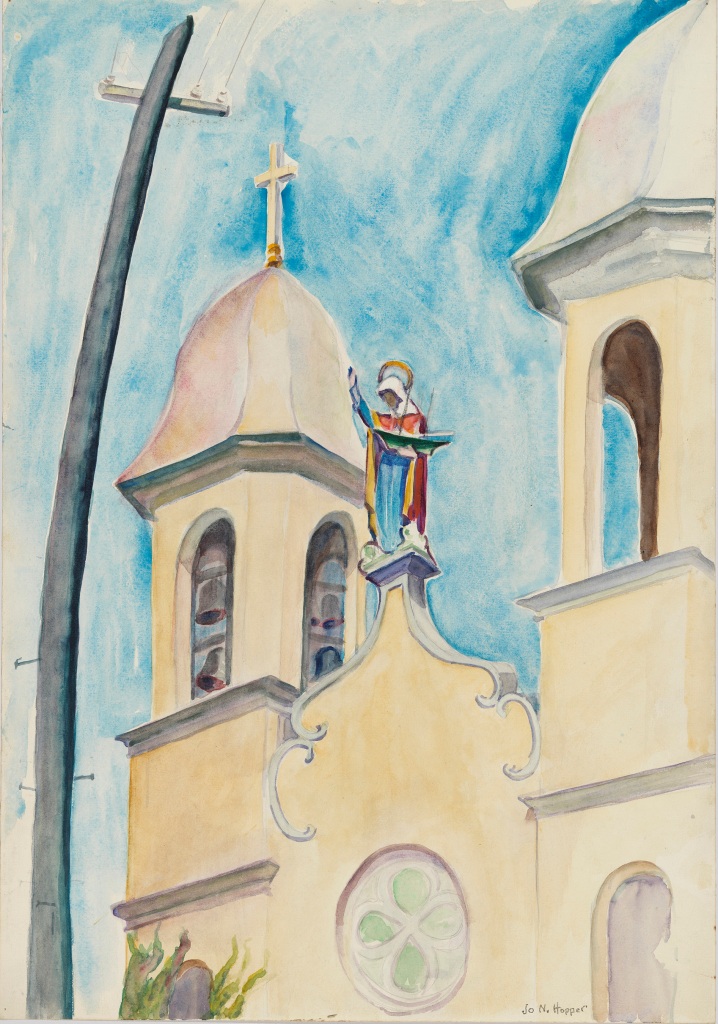
A few days ago I posted a review of the Hopper exhibit at the Cape Ann Museum in Gloucester, Mass., in which I described a painting by his wife, Jo N. Hopper, while admitting regret that I could not find it on-line.

Kind thanks to my friend, Tom Febonio of Rockport, a quaint fishing village right there at the tip of Cape Ann with Gloucester, who found it in a review of the exhibit by the Washington Post:

What fascinates here is the bend of the telephone pole toward the cross, as if drawn by a magnet, and the readiness of the Madonna’s outstretched hand to hold it up.

From a modern perspective, there may not be much more to say of it, but one century ago, Jo Hopper was looking at a brand new technology with an infrastructure that literally towered over the towers that congregations–that people–built to worship their God. When Europeans first settled in North America, most every village had a rule that nothing could be built anywhere nearly as high as a church steeple. Did Jo Hopper see an offer of collaboration or an imminent revolution? Was the hand raised in acceptance or resistance? And what of the identical T shape?

Since this is a much closer look at the church than was the painting I posted with the review, it’s worth noting the Spanish Revivalist architecture that we associate with the American Southwest and which, in this case, jolts many an unsuspecting New Englander visiting Gloucester for the first time.

Originally built in 1892 to serve a large Portuguese population that came to work in the local fisheries, it burned down in 1914, but was rebuilt by the 1920s when the Hoppers began spending summer vacations on Cape Ann.

The new church is nearly a replica of the Santa Maria Madalena church on one of the Azores islands from which most of the immigrants came. Our Lady of Good Voyage was added to the list of National Register of Historic Places in 1990.

-30-

Postscript: In addition to the fishing industry, many Azorean natives joined both the whaling and shipping industries, as Herman Melville tells us in a magazine piece from the 1850s titled “The ‘Gees” (with a hard G).  Following descriptions that are mostly laudatory–including an unsurpassable work-ethic–and at other times reflective of the prejudices of Melville’s day, the summary line is more characteristic of Ishmael, his open-to-all and dismissive-of-none narrator of that novel he penned at about the same time:

’Gees are occasionally to be encountered in our seaports, but more particularly in Nantucket and New Bedford. But these ’Gees are not the ’Gees of Fogo. That is, they are no longer green ’Gees. They are sophisticated ’Gees, and hence liable to be taken for naturalized citizens badly sunburnt. 

Painting by Alpini Gionatan of the volcano on one of the Azores, the main cause of emmigration.
https://www.inkroci.com/culture_movie/the-stories/classics/herman-melville.html

To Go On When There Is No Cure

If you ever wondered how Kathy Bates would sound–or look–singing the Chiffon’s 1963 number one hit “He’s So Fine” with Maggie Smith on backup vocals, The Miracle Club is for you.

Young enough to be Smith’s great-grandaughter, Irish actor Agnes O’Casey do-lang-do-langs alongside her, a sight-gag with matching dresses. Before the last Oh, yeah, Laura Linney will join them–not behind the microphones but on a long bus ride from Dublin to Our Lady of Lourdes in the French Pyrenees.

As a quartet, they represent four generations, and with Dolly’s (O’Casey’s) young boy taken along for a cure, we could say five. This accounts for a tension barely noticeable at the start of Miracle Club that hits hard when Chrissie (Linney) returns from Boston after 40 years of silent absence to the row-house hood for her mother’s funeral.

As a film of re-generation, the mood and the pace of Miracle Club is comparable to other recent Irish and British films such as The Quiet Girl, The Duke, and Living.

Gradually we’ll learn that much is not what it seems, and that what links these women to each other is well in the past, present only in pictures on walls–or is it the future of the young boy looking into the snow globe he brought back to Dublin at the film’s end?

Rather than spoil it–or issue an alert–I’ll leave all that unexplained and say simply that, more than anything, Miracle Club is a film about reconciliation. For a capsule review, I cannot top Allan Hunter of Screendaily:

As the women set out on a journey each of them hopes will change their lives, along the way, old wounds are reopened, and the travelers are forced to confront their pasts. A quietly feminist film that honors the invisible labor of women, the complexities of motherhood, and the belief that change is possible.

In that, the “quietly” in front of “feminist” partly refers to the portrayal of three husbands left behind. There is one ugly moment and a few insults that in 1967, when this takes place, didn’t draw the offense they would now. The return to Dublin from Lourdes is another round of reconciliation, served as dessert after a full meal. Other than that, these scenes are played for comedy, especially the leak in the plumbing staged by Lily (Smith) for her getaway.

Call it comic relief from the traumatic revelations, accusations, and confessions we hear from the women in Lourdes. As the priest consoles a demoralized Eileen (Bates) when they leave, it’s not the cure that you look for, but the strength to go on when there is no cure.

In Lourdes, forced or not, the women relive their pasts. While miracles fail to occur, reconciliation beckons–or “peace” to use Chrissie’s word. That’s the Miracle in The Miracle Club.

-30-

Playing at the Screening Room in Newburyport now through Thursday, October 5 @ 4:30 each day:

https://www.newburyportmovies.com/the-miracle-club
https://www.imdb.com/title/tt12712604/

Hoppers on Cape Ann

When New Englanders say The Cape, it’s always understood to mean that imposing arm of a sandbar that flexes its bicep in the Atlantic and shakes a clenched fist at the Old World.

Those of us who live north of Boston are fine with that, as we play host to enough tourists who know of the beaches, the promontories, the lighthouses, the docks, the harbors, the woodlands, the trails, the fishing villages, the clam shacks, the orchards, the farmland, the castles, the theater troupes, the dance companies, the music ensembles of Massachusetts’ Other Cape that reaches from the coast like a hand open to all.

Cape Ann Pasture, Edward Hopper

While many artists have captured the beauty of Cape Cod on canvas, it’s hard to imagine that any have so thoroughly and repeatedly brought it to life as Edward Hopper (1882-1967) has done with Cape Ann.

May be hard to think of the creator of Nighthawks as a landscape (or seascape) painter, but the proof is on exhibit now through Oct.16 at the Cape Ann Museum in Gloucester, a thriving fishing port that Hopper and his wife, fellow painter, frequent model, and life-long muse, Jo Nivison Hopper, frequently visited in the Roaring 20s.

Any scape is equally misleading for an exhibit with so many paintings of buildings, featuring architecture as diverse as the dual towers of the Portuguese church and the mansard roof of the home of a wealthy merchant.

The Mansard Roof, Edward Hopper

But the overall impression is not so much of wood and bricks, boats and railroad cars, streets and water, or even trees and rock, harbor and surf.

All those subjects are on canvas, making the exhibit well worth the view.  But Edward Hopper & Cape Ann: Illuminating an American Landscape is most memorable for the lighting in which we see the buildings and boats.  Hopper was the artist, but Cape Ann is the star of the show.

House by ‘Squam River, Gloucester, Edward Hopper

Tempting to say the show was stolen by Jo N. Hopper as she signed her name to the ten or so canvases the filled a middle area surrounded by her husband’s work.  A telephone pole curving toward the church steeple strikes me as an essay I dare not write, although a few draughts of Fisherman’s Ale at Blackburn’s Tavern may change my mind.

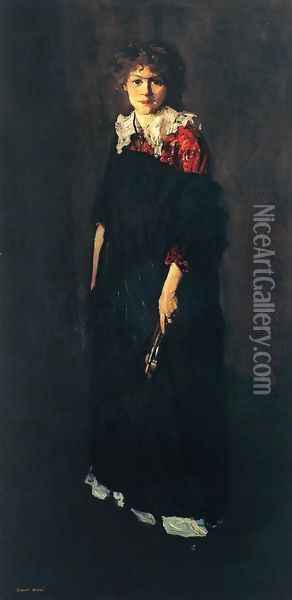
Her husband’s portrait of her is memorable for the ingenious angle at which he took it, and her self-portrait well past middle-age fascinates us with an inevitable comparison to another of her as a teenager.  Called The Art Student, this was by Robert Henri who taught at the art school where Josephine Nivison and Edward Hopper met. According to the paragraph on the wall, she appears as “a little human question mark.”

But there’s no question over how either painter regarded Cape Ann.  Every canvas is a statement, an offer made by an open hand.

-30-

https://www.niceartgallery.com/Robert-Henri/The-Art-Student-Aka-Miss-Josephine-Nivison.html
No photos allowed at the Cape Ann Museum, and Jo N’s painting of Our Lady of Good Voyage with the telephone pole leaning toward it is nowhere to be found on-line. (If you can, please let me know,) Here’s one she did of the Portuguese church from another angle.
Prior to Cape Ann Museum, the only Hopper I had seen up close was Nighthawks at the Institute of Art in Chicago in 2008. Photo by Michael Boer: https://www.flickr.com/people/onewe/
A painting by British painter Phil Lockwood (born 1941) in which every window is Edward Hopper’s painting, even the bar-cafeteria is a Hopper.

A Rye Toast to Salem 1691

Yes, I’ve joined the cast of Salem’s Cry Innocent, but I’m tempted to plead Rye Guilty.

As kids, every American hears of Salem’s witch trials, and every October reminds us of them in living black and orange.  An official holiday or not, Halloween is Salem’s night to moonshine.

Missing here is why.  We know what:  An estimated 150 people were imprisoned for witchcraft.  At least 19 adults, most of them women, were executed—though we rarely hear of the two dogs also put down.

In lieu of any scientific reasons, all of the hallucinations, the convulsions, “St. Anthony’s Dance,” the skin lesions, the screaming and erratic behavior are attributed to the devil.

I’d say all of the mischief as well, but one theory holds that a Rev. Parris pushed some accusations to acquire vacated land. Another emphasizes the panic caused by a smallpox epidemic.  Both, however, may be called pretexts for exploiting or misinterpreting teenage girls acting, looking, and sounding abnormal, often with menace.

For nearly three centuries, no scientific reason was offered until 1976 when a doctoral student at Renssalaer Polytechnic Institute noticed that similar outbreaks occurred earlier in various parts of Europe, all of them with identical symptoms suffered mostly by young girls. What these regions had in common were crops of rye, a grain then far more common to diets, and exceedingly wet seasons prior to the outbreak.

That sent Linnda Caporael, who would complete her doctorate at RPI, into the diaries of Salem villager Samuel Sewall who noted a wet, warm spring of 1691 followed by a hot, stormy summer.

Though it went unnoticed through most of the 18th Century, the excess moisture caused the growth of ergots—small, purple bulbs—on rye grain.  Farmers likely thought nothing of it, may not have even noticed it, as they harvested and later milled the crop. According to the Encyclopedia Britannica’s website:

Since medical knowledge was sparse, the presence of darker shoots on rye was probably thought to be the product of overexposure to the sun.

Not only is it toxic, but hallucinogenic.  The young girls, with their not-yet-fully-developed immune systems, started acting out late in 1691, and the hysteria was in full swing by year’s end. Almost all of these cases, Caporael found, were on the west side of Salem Village, where there was considerable marsh compared to the rocky east side. Whereas rye was a “common crop,” harvested by and for the immediate community rather than individuals, this fit her theory. Most of the hearings and trials were held in 1692, coming to an abrupt end, Britannica tells us, “quite simply because Salem ran out of ergot-contaminated grain.”

Caporael’s finding has been rejected by some historians who point out that, even in the 17th century, midwives knew how to harness ergot for inducing labor. Says one:

(T)he visions seem to come and go with the afflicted in ways that are more controlled than a hallucination would cause… [E]rgotism leads to gangrene and there is no documentation of the accusers having gangrenous limbs–even while other symptoms (admittedly similar…) are written about with detail. 

Since ergotism was unknown at the time, Cry Innocent has nothing to do with it. So I’m well offstage and away from the cast when I ask: Does an outbreak in one place have to duplicate every symptom in another to be considered the same, or even related? As Britannica tells us:

With the exception of a few events likely triggered by groupthink and the power of suggestion, behavior exhibited in 1692 fits the bill of rye-induced ergotism…

Perhaps it was ergotism that triggered the groupthink and manipulation. Perhaps an American strain lighter than that which produced gangrene in Europe. As always, when you mix history and science you get theory, never to be 100% pinned down and always ripe for debate.

No doubt due to the immediate opposition in 1976, Caporael’s report was not widely circulated.  There may have been public resistance as well. After all, as any child will tell you—and as any actor or director will quickly agree—villains are the highlight of any story.  Satan versus ergot bulbs on rye grain?  No contest!

Be that as may, count me as among those who espouse the theory. To a child of the Sixties, the hallucinatory properties seem close enough, and it is more than glaring that no explanation other than Satan has ever been offered.

The tide turned in October of 2012 when Discover Magazine published an essay comparing Salem’s trials to the Vardo trials in northern Norway throughout the 17th Century:

Hundreds of women were accused, and 92 burned at the stake for the crime of witchcraft. Ergot poisoning has also been suspected in several “dancing mania” events in Europe, in which masses of people danced randomly in the street for hours.

Two months later, Live Science offered an irresistible parallel to account for Santa’s annual trips around the world:  Hallucinogenic mushrooms in northern Finland, a place with very few people, but many of them shepherds.  About as close to the North Pole as you can get, this is where the reindeer, if not the antelope, play.  After bites of mushrooms, shephards saw them fly.

Another character we think of as myth, is actually based on a historical figure.  According to one of a handful of theories, he used laced bread to entice children to leave a Saxon village in 1284. If true, then for the Pied Piper—my ancestor so to speak—the music was more analogous to taking loaves from the oven than to the baking of the hallucinogenic bread he fed those kids.  His flute served as an aural oven mitt.

Medical News Today could have had him in mind when it reported that LSD “is not the same as ergot fungus but contains some similar compounds.” The magazine did include the Salem trials in an extended diagnosis last year, offsetting the poison with a report of extracts with medicinal value for migraines and childbirth–as well as current research for Parkinson’s and Alzheimer’s.

Even Bon Appetit served up Salem’s contaminated rye, though it should have changed its name to Mal Appetit.  One wonders if they were using the story to steer us toward French baguettes.

As for me, my sandwiches between performances will still be on dark rye. After the summer we’ve had, it may be all I need to stay in character.

-30-

Note: Nearly two years after writing this, I chanced upon a 1991 book titled Poisons of the Past by Mary Kilbourne Matossian who explains that ergotism has two strains: gangrenous and convulsive. That Salem’s young girls had no gangrene, therefore, does not rule out that they were afflicted by the latter strain. See: https://yalebooks.yale.edu/book/9780300051216/poisons-of-the-past/

Detail of TRIAL OF TWO WITCHES by Howard Pyle (1853-1911).
http://www.granger.com.

Sources:

https://www.britannica.com/story/how-rye-bread-may-have-caused-the-salem-witch-trials

https://www.discovermagazine.com/mind/this-hallucinogenic-fungus-might-be-behind-the-salem-witch-trials

https://www.bonappetit.com/entertaining-style/pop-culture/article/how-a-bad-rye-crop-might-have-caused-the-salem-witch-trials

https://www.medicalnewstoday.com/articles/ergot-poisoning#history

https://www.livescience.com/25731-magic-mushrooms-santa-claus.html

Pay the Piper! A Street-Performer’s Public Life in America’s Privatized Times (2014), page 17.