And the Times, They are a’Weird

When Coach Tim Walz added “weird” to the Democratic vocabulary, he nailed the weird Bonespur and his equally weird Project 2025 frontman running-mate to their own ridicule.

‘Bout time our side started hitting back. The Michelle Obama rule, “When they go low, we go high,” was all very nice, but our political reality is anything but nice. In keeping with the Minnesota governor’s quick wit, the DNC is issuing lawn signs to reflect the change:

When they go wird, we go Walz!

Why the DNC chose to misspell it may or may not be weird, but I can’t think of a presidential campaign in which a single word landed with so much force. And I took notes on Kennedy vs. Nixon. Or a single VP selection who entered the race with such an immediate impact–and one without a national profile no less. Spiro Agnew, an unknown Maryland governor in 1968, just added to the malice already set by Nixon’s “Southern Strategy.”

A quick wit and a life-long commitment to public service–including soldier and educator both in the classroom and on the athletic field, hence the name, Coach–will do that for you.

And I must thank Walz for what he has done for me. Since his acceptance speech in Philadelphia, I’ve had a modest run on my 2018 book, Keep Newburyport Weird, more copies in the past three days than in the last three years. Why, it is outselling Once Upon an Attention Span, the book I published earlier this year.

In a way, that might be embarrasing, but hey, I’m still working on Beach Bum Elegy.

-614-

Rather than a description which could never do it justice, here’s a video of his 18-minute speech:

Fool Me Twice

In the laundromat today, the back of a shirt worn by a fellow loading a washer caught my eye.  At the top, in large letters, I read “Stop…”

Couldn’t see the object of that most demanding verb, but I thought I knew.  Younger I would likely have confronted him, but futility appeals not to Older Me or to My preoccupied state of mind on laundry day, if not every day.

All I craved was to transfer my laundry from washer into a dryer so I could set up shop with Lenovo and a Costa Rican roast at the coffee shop next door.  Maybe I’d write about the idiocy of the “Stop the Steal” movement, especially now that a Supreme Court justice is flying its flags.  Or maybe I’d put it in my 2S2BW file–Too Stupid To Bother With.

In the coffee-shop, I went right to a recent blog awaiting its turn to appear on social media. My first film review in a couple of months with the headline, “Better Not to Dwell on It.” Couldn’t help but laugh out loud at how well that fit the laundromat scene I just described.  In fact, I paused for a moment thinking I might find another headline and save it–only to realize that, in so doing, I would be dwelling on it.

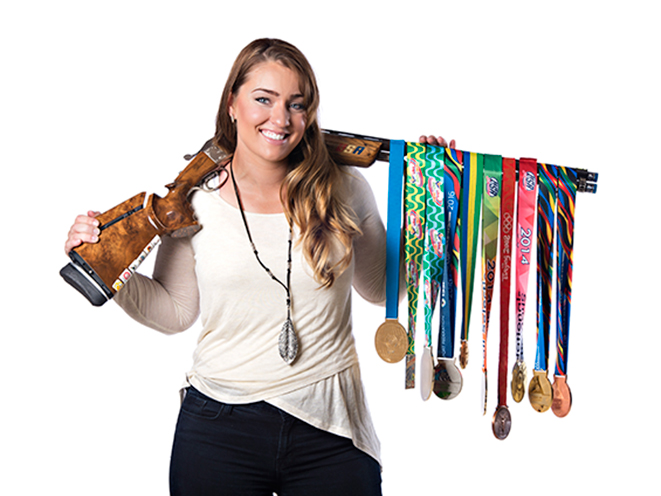
So, onto the feed it went just above another post as arresting to my eye as the word “Stop” in the laundromat.  Actually it was a re-post of a meme showing a smiling young woman, an Olympian, holding a medal she had won.  The text began with a newspaper headline:

Wife of a Bears’ lineman wins bronze medal today in Rio Olympics.

Below that, the person who posted the meme added:

You spelled ‘3-time Olympian Corey Cogdell-Unrein wins second bronze medal today in Rio Olympics’ wrong.

Yes, having delved into sarcasm myself, I’m a sucker for it.  At first, I was fooled and all in favor of the correction.  Why should anyone’s identity depend on a relationship to someone else?  But then I noticed the identity of the original poster at the top of the meme, just above the woman’s smile and medal and the text I just quoted:

The Chicago Tribune.  How else could a headline or caption say “Bears” and let readers assume it is Chicago’s NFL team?

Quickly, in hopes of leaving the first comment (and perhaps convincing my friend to delete the post before it spread), I typed the Olympian’s name into a search engine.  It was all I needed.  Here’s the comment I left:

The newspaper is in Chicago. The Olympian is from Alaska. Her husband plays for a team based in Chicago. The editor needs a “hook” (i.e. a connection) between the bronze medal and the readers (residents of Chicago & northern Illinois) or the story doesn’t even run–as it did not in, say, Boston, Baltimore, Philly, etc. The husband is the hook. Hence, the headline.

I might have added that this is why right-wingers laugh at us.  The meme is a triumph of political correctness over practicality and natural tendency.  If this were a national publication, then, yes, the headline would be sexist and offensive–not to mention that it would get an F in any journalism class for naming “Bears” without “Chicago” in front of it.  As is, the meme makes us (liberals) look petty and uninformed.

Done with the lesson in Journalism 101, I swilled down the Costa Rican, shut down the Lenovo, and returned to get my laundry.  Before re-entering Village Washtub, I spotted the “Stop” shirt, stood still for a long sigh, looked at the sky, rolled my eyes, exhaled, and said under my breath, “No, don’t do it!”

Even at that, I didn’t know if I’d do it or not or even what it was I would or would not do.  Nor will I ever find out.  As I entered, the fellow walked toward the door, left to right until directly in front of me, but then turned the other way, giving me full view of his back.  His shirt read:  “Stop Making Sense.”

Well, how can I argue with a fellow fan of the Talking Heads? How can I object to the title of their legendary 1984 concert film re-released last year when I watched it every night I projected it? Like faulting a newspaper for making a local reference in a headline, it wouldn’t make sense.

Or is not making sense what I am now supposed to start?

-599-

Corey Cogdell-Unrein and her medals for Trap Shooting. Photo courtesy of Athlon Outdoors. https://alaskasportshall.org/inductee/corey-cogdell/

An Oxyhistory of the Oxyfuture

When my friend heard Sam, his 11-year-old grandson, say that he couldn’t think of a title for a school writing assignment, he suggested that the boy call it “a history of the future.”

Sam was momentarily confused, or maybe stunned, but soon snapped out of it and hastened into an adjacent room: “Mom! Grandpa’s at it again!”

Sam may not like the oxymoronic idea, but I’ve seen enough of this moronic world that I believe it could use some oxy. If you didn’t know that “oxy” is a prefix meaning “keen” or “sharp,” and even if you did, what follows is my oxyattempt to imagine myself as an oxyhistorian in the year 2100, starting with a title characteristic of the time:

Duckspeak🙂 – English😡 – American😧

You are now reading an account of the devolution of the English language in America in the 21st Century which has just ended. This is necessarily anonymous because any writing in excess of 20 words is now illegal, and because most of the words I use are not on the list of just 40 words and 12 emojis approved for written communication.

By 2060, so many words were banned that it became easier to consult an approved list which, when last checked in December, 2099, was down to 40 not counting geographical, business, and personal names. All other words have been condemned as “inappropriate” (meaning either offensive or elitist, or confusing or difficult, or pretentious or assuming, or any other reason the speaker may have for not liking it).

After wrestling with “preferred pronouns” in the first three decades of the century, the “Appropriate Police” (AP) banned all singular pronouns and modified “they” to a choice between “o-they” and “p-they,” short for “onethey” and “pluralthey.” Appropriately (consequently), we also have “o-them” and “p-them,” “o-their” and “p-their.” To help the plan along–or perhaps as a result of it–abbreviated spelling was encouraged for many remaining words. “Vacation” became “vaca,” “supermarket” became “supe,” and “government” contracted into “gummint.”

Some words were purged by “Voca-Check” (as in vocabulary), an app perfected in 2035 that replaced them with an AP-appropriate (approved) word. “Citizen” is now automatically turned into “consumer,” “city” becomes “market,” and so forth. Other single words replace inappropriate (detailed) phrases, such as “inflation” for “record-breaking corporate profits.”

Included in this wave of reforms, the letter X is now used to reduce a line such as “he and she repeated it ten times” to “p-they ten-xed o-them.”

In 2040, the AP declared it appropriate (permissible) that all nouns could and should be used as verbs. This grew from a trend started by Madison Avenue soon after the turn of the century to advertise names of seasons, activities, and even of brands being sold as verbs. “In New England, we Honda!” “No matter where you holiday!” “We business for you!” “You’re gonna cashback!”

Punctuation? That was also declared inappropriate (annoying) and banned in the year 2033, following the flurry of reports in the 2020s–ranging from USA Today (now an advertising sheet) to the NY Times (now extinct)–that Gen Z’ers and Millennials found periods rude and abrupt, question marks threatening, and exclamation points better expressed as smiley faces or wow faces or clapping hands, etc.

By 2035, the Chicago Manual of Style, the Associated Press Stylebook, and Strunk & White’s Elements of Style were all deemed inappropriate (obsolete) and replaced by Emoji Protocol. In addition to the twelve emojis appropriate (approved) for public consumption (i.e. social media), Protocol offers a “relatively alternative history” of emojis based on what it calls “re-evolution.” In it, all alphabets are devolved from hieroglyphics, which was a higher form of expression than anything penned on paper, typed on keyboards, or written on subway walls and tenement halls. Shakespeare be not!

Emojis, according to Protocol, have put a halt to this devolution. Hence, the claim to re-evolution. In 2055, when everything ceased to be printed, the images of book covers on the screen were called “Cuneiform Art,” and used mostly as cartoons. The first Samsung mobil device from the century’s first decade, because it was the only one to ever include semi-colons, became a prized collector’s item–so rare, that it is called “The Rosetta Phone.”

In addition to making the world appropriate (safe) from punctuational abuse, all adjectives with one or two exceptions (depending on how you count) were banned in 2040. All were found to be inappropriate (judgmental). By 2025, words such as “stupid” and “ignorant” were banned as name-calling and/or because they made people feel bad.  That done, the self-appointed AP then cracked down on the implication of complimentary words. No more calling anyone “smart” because it implies that others are not smart.

All now-banned adjectives that once described a person’s abilities or attributes–intellectual, physical, artistic, artisanal, social, personal, creative, imaginative–are listed in an appendix to the AP Appropriatebook. A second list includes descriptive verbs, and a third adds adverbs that describe the subject as much as the verb. The three-part, 12-page appendix is titled, “Everyone Trophys.”

The excepted–and accepted–adjective is “appropriate,” the lone approved word to be applied to anything the speaker favors. This includes “inappropriate” for anything not favored. Young people and older folks who want to sound young may use “cool” and “uncool.” These serve as oxysynonyms, which is to say that they have the same meaning only because, like “appropriate” and “inappropriate,” they mean nothing, the inevitable result of being used to mean everything.

As far back as 1977, before the century-long purge of American English began, as a reaction to a national economic decline that squeezed state budgets, college deans started using “appropriate” to mean anything that met their approval.  The purposefully vague value judgement of the word allowed them to assume agreement, avoiding any inappropriate (inconvenient) debate precipitated by words such as “relevant” or “engaging.”

Even more appropriately (sanitizing) than that, the all-purpose word offers nothing precise, or that can be measured in any way, unlike words such as  “urgent” or “challenging” for values once at the heart of education but which proved too inappropriate (complex, uncomfortable) after the inappropriate (troublesome) Sixties. The world of business quickly picked up on “appropriate,” finding it both appropriate (efficient) and appropriate (cost-effective), and public officials soon followed suit when “appropriate” proved to be an appropriate (reliable) way to perplex reporters asking inappropriate (revealing) questions.

By 2050, a few elderly cranks were protesting what they called “dumbed down language” and comparing it to the “Doubleplusgood Duckspeak” forecast by George Orwell in 1984, perhaps the most renowned “history of the future” ever written. But the protest backfired when college students noted that Duckspeak didn’t offend anyone and that ducks made “doubleplusgood emojis.”

In 2057, Ding Dong, the student newspaper of Dog and Dinnerbell Univerity, called Duckspeak “the most appropriate (simple) language for safespace.” A tide began to surge. In 2059, Dingaling, the AI algorithm that provides content for student papers with options allowing editors to make it appropriate (relevant) to individual schools, offered a feature calling 1984 “not the warning that liberals always hate on, but a blueprint to rock America!”

By 2064, a new political party emerged from the cold ashes of the Democratic Party that committed political suicide–by pitting an insistance on immediate perfection against a willingness to accept accesssible good–mixed with the confused mush of MAGA, a cult that smothered and replaced the Republican Party while retaining its name. Riding the tide set by D&DU, Dingaling renamed it The Duckspeak Party.

By 2068, enough Americans were so in love with the ease, so enthralled with the oblivion, so convinced of the freedom, and so protective of the right not to care about anything other than themselves that the Duckspeak tide proved a tsunami. English drowned as America began to be ruled by whatever algorithms Dingaling could set. Politicians existed only as fronts, chosen for their entertainment value and their fluency in Duckspeak such as:

I have broken more Elton John records, he seems to have a lot of records. And I, by the way, I don’t have a musical instrument. I don’t have a guitar or an organ. No organ. Elton has an organ. And lots of other people helping. No we’ve broken a lot of records. We’ve broken virtually every record. Because you know, look, I only need this space. They need much more room. For basketball, for hockey and all of the sports, they need a lot of room. We don’t need it. We have people in that space. So we break all of these records. Really we do it without like, the musical instruments. This is the only musical: the mouth. And hopefully the brain attached to the mouth. Right? The brain, more important than the mouth, is the brain. The brain is much more important.*

Whether there’s a brain attached or not, Duckspeak was deemed “doubleplus appropriate” because it simplified everything. Comparisons, no matter how slight, were effectively banned because they could no longer be considered anything other than full-blown equations. State any rhetorical or symbolic similarity between MAGA at the beginning of the past century and the Nazis in the previous century, and you were slammed for accusing MAGA of running gas chambers. Fascists rose to power in the early 21st Century because their tactics could not be mentioned in the same sentence as those used by early-20th Century fascists to gain power. Hence, whole populations fell for the same deceptions. Instead of learning from history, we fell off the Cliff Notes of easy-does-it denial.

Ditto explanations. Documented reports of the violence caused by corruption of Central American governments were dismissed as excuses for an “invasion” of America’s southern border. No one wanted to hear of the US government’s decades-long relations to or meddling in places like Guatemala or Honduras. “Just an excuse!” Calls to stop genocidal bombing in Gaza were twisted into accusations of anti-Semitism even as Jewish people joined in those calls. You might as well call for a second Holocaust. And let’s have no talk of the Mediterranean oil fields off Gaza’s coast that Israel will not allow the Palestinians to drill. Context means nothing. Cause-and-effect relationships have ceased to exist.

In America’s 21st Century, Truth itself became nothing more than a weak-kneed excuse. Any comparison to history was deemed offensive. There is no past. Nor is there a future. That’s why it’s so easy to write a “history of the future,” a phrase that only appears to contradict itself while offering its very appearance as a verbal trick.

There is only Now.

-590-

*Donald Trump, rally in Montana, July 5, 2018.

Facing Perception

Whoever first said “perception is reality” may have been joking, but it is now the law of the land.

Nor am I exaggerating to make a point when I call it “law” as if it were as expected and enforced as a red light for stopping traffic.

The very phrase itself became the latest example–and victim–of the dumbing down of America this past weekend when the Republican candidate for president announced his position on reproductive rights:

My view is now that we have abortion where everybody wanted it from a legal standpoint, the states will determine by vote or legislation or perhaps both. And whatever they decide must be the law of the land — in this case, the law of the state.

Put aside for a moment the fact that, in the very same speech, he boasts of “getting rid” of Roe v. Wade. Put aside, too, his attempt to appeal to Nikki Haley voters, particularly women, by declaring that the recent Arizona ruling “went too far” moments before he takes full credit for the Dobbs decision which made that ruling possible. And if it’s possible to keep putting things aside, pay no attention to his implicit, yet transparent assumption: He fully believes and is openly boasting that his three appointees to the Supreme Court exist to do his bidding.

Though his new and re-worked claim is nothing more than lipstick on a pig, let’s treat Porky as Porky says he is:

The placement of the word now in the prepared statement from which he read is curious. As an egomaniacal reality TV-star, he was all pro-choice, and he has wavered since then depending on where and to whom he speaks. Does “now” mean “for now,” as in temporarily?

Far from that, he wants it to sound certain, as a core value should. For his base and for those who take things at face value, that’s the perception. Considering that his track record is null and void of core values, we can bet on now meaning from here to November. That’s the reality.

Where everybody wanted it is equally revealing. This distorts language in much the same way that the Electoral College distorts democracy. As many as 49.9% of voters in states as large as Texas and Florida can go one way, but all 38 and 29 electoral votes go the opposite.

Republicans bank on supporters who identify as citizens of rural red states–“the real America” as they sometimes call it–in opposition to the “urban, coastal, liberal, elites” as they call the rest of us. Their “real” America now has what they want: bans. The rest of Trump’s “everybody” have what we want: reproductive rights–or, what they would call sin. That’s the perception.

The reality is worse. Most judges are not elected but appointed, and their approval comes from legislatures in states highly gerrymandered to favor Republicans. This explains why voters in states as conservative as Kansas overwhelmingly favor reproductive rights when they are put as referendum questions on ballots. News commentators have a word we keep hearing more and more to describe this: circumvent.

Then comes his sleight of hamfistedness of by vote or legislation or perhaps both. Vote comes first to create the impression of freedom, free choice, a democratic, truly American process. That’s the perception.

Reality? Republicans hope vote will mask the legislation already coming from and much of it already passed by the many state senates and houses of representatives they control. The word perhaps in front of both is a cute, Trumpish touch.

At the end of the statement, he adds another such touch, in this case… Intended as a qualifier, it suggests that the land–which has always been understood to mean America–can exist as one country in which people live with different sets of civil rights. That’s the perception.

Reality? As Abraham Lincoln told us, a house divided cannot stand.

If that’s reaching too far back, then let’s consider the reality check we experienced in the weeks after the Mitch McConnell-stacked Supreme Court gutted Roe v. Wade:

Until that decision, all Republicans were calling for repeal on the grounds of States Rights. As soon as Roe was overturned, Republican-controlled states were like a long, straight city street where you can see all the traffic lights lined up for six or seven blocks. Imagine them all changing at once. The green of States Rights went off, and with no hint of yellow in between, the red of a federal ban came on.

To call for a national ban, Republicans ditched States Rights like a used condom. (Well, it served it’s purpose, and then it was messy, so…) They may be letting the states quibble about the number of weeks, if any, or the nature of exceptions, if any, but all of them called for bills out of the US Senate and House of Representatives.

The historically accepted term for what they want is the law of the land.

Of course, they need a Republican president to sign it, which is why their presidential candidate dodges the question about signing such a bill–as well as why he conflates popular votes with party-controlled legislation. Instead, he hides behind States Rights, just as Republicans have done since 1973 when Roe v. Wade became law of the land.

The challenge for Democrats from here to November is to force voters to face perception. They can do that by putting reproductive rights on the ballots of every state they possibly can. As happened with the issue of same-sex marriage back in 2004, the wording of the question may vary from state to state, but that doesn’t matter. Worded to elicit a yes or no answer doesn’t matter. All that matters is that all Democratic candidates attach themselves to it.

That’s the reality.

-586-

American history or 21st Century congestion, all the lights are red. Photo taken from in front of Chicago’s Museum of Art, 2008, by Michael Boer: https://onewe.wordpress.com/

Roe’s Role Reversal

We’ve seen this movie before except that the blinders were on the other sets of eyes.

And our own eyes at that! The year was 2004 which began with George W. Bush looking like a weak incumbent doomed to defeat in his bid for re-election.

Took the Democrats a while to settle on John Kerry, but as I recall, all of his primary opponents and their followers united behind him.

Twenty years ago, however, the hot-button issue was not abortion. It was same-sex marriage, and the country simply was not ready for it–as it is now. In the Bush camp, strategist Karl Rove recognized this and put the word out to Republicans in the battle-ground states to find some way and some wording to get it on the ballot as a referendum question. Many who never bother to vote, he figured, would be out to turn it down. Once in the booth, they’d fill another oval in for the candidate–or party–associated with their cause.

Exit polls proved him right. Voter turnout was considerably higher in several states, a few of which the issue likely flipped, including Ohio with 20 electoral votes that would have changed the outcome all by itself. Same-sex marriage went down in flames, taking Kerry with it.

Though the issues have flipped into public favor, the plot is the same. If Democrats need someone to play the Karl Rove role, I hereby volunteer. And there’s a lot to work with…*

Last week, a court in Florida ordered that reproductive rights be put on the November ballot. Some pundits are now saying that, in November the state, despite DeSantis, will be in play.

This week, an Arizona court returned its state back to draconian laws written 50 years before statehood–and before women had the right to vote–that would make all abortions illegal, no exceptions. What’s to stop Arizona Democrats from putting the issue on the November ballot? What’s to stop Democrats from putting Wisconsin, Michigan, Pennsylvania, and Georgia in play?

Do it in Texas, and you might not top Trump, but you might get Colin Allred to replace Ted Cruz in the US Senate. Do it in Ohio, and you’ll give Biden a fair chance while guaranteeing Sherrod Brown’s re-election to the Senate. Do it in New York and other states where you may think you don’t need it, and you’ll pick up seats in the US House.

Give Biden and Harris a Democratic House and Senate, and Roe v. Wade will be restored as law of the land.**

-30-

* & ** Turns out that Law of the Land, a time-honored and immediately-understood phrase, has this past weekend been turned into yet another verbal trick–a value steeped in patriotism now stained in deceit. Tomorrow’s blog, “Facing Perception,” dissects Trump’s recent statement on abortion which is, all by itself, plenty to work with.

Literally in Other Words

A good and long-time friend has advised me to avoid name-calling. Pretty sure I have avoided that in print–and if I didn’t, an editor would let me know.

As well as in these blogs, although there are times when I get so caught up in the raucous tone of satire, I may have let fly a Trumporon or Trumbecile at those in the crowds who laugh and cheer, hoot and jeer everytime he “jokes” about inflicting violence on judges, juries, and their families–or, as he is emphasizing in recent weeks, promising to pardon all the convicted criminals who desecrated the Capitol and inflicted violence on police on Jan. 6, 2021.

Don’t quite know how to be polite to–much less respectful of–those who cheer for violence and laugh at suggestions of hangings and firing squads, but if you see me put the term “human beings” in quotes, you’ll know I’m trying.

My restraint is especially tested when I see or hear a well-used analogy that calls for completion. When the same friend posted a meme telling us that…

DJT selling Bibles is like Hannibal Lechter selling cookbooks…

I suggested that he might be calling those who buy those damned or blessed books–depending on your point of view–cannibals, all while being mighty careful not to use that word myself.

Perhaps he’s a political vegetarian. He didn’t take the bait, and so I started reeling myself in–only to find that another friend, one here in Newburyport, has decided to try his hand at poetry. And there, as a screaming subject line on an email, was the title of his first attempt.

Before I reveal it, let’s be fair to the good fellow, a man of my boomer, often boomed, but still booming generation. Turns out he and I were colleagues (of sorts) for one summer in the late-70s or early 80s, whichever came first: he, a white-collar guy for 3M in St. Paul, Minnesota; me, a temporary assembly-line roustabout in a huge warehouse 3M built to avoid Minnesota taxes just over the state line in the college-town of Brookings, South Dakota.*

In other words (literally in other words), he and I share a turn of mind that has both of us looking for new ways to express ourselves when we “find wrong and try to right it.” Obligation may be the driving force, and solutions–ranging from fair treatment of local workers to clean air and world peace–may be our destination.

But damn it, don’t we deserve to have some fun along the way? Don’t we need to laugh? Quaff some Guinness? Don’t those willing to hear us want and need to laugh? Quaff what they will?

As my turned-poet friend puts it, “Thirst is a dangerous thing!”

And I keep finding over and over again and again that those who don’t laugh make me thirsty, in part because I have this odd intuition that their inability or unwillingness to laugh betrays a thirst that is killing them.

But I ingest. Before anyone gets drunk on that metaphor, let me remind you that I found this email when I had just resolved to guard against name-calling. So the title came as a shock, and my initial instinct was to change it. But no, better to offer it under the title that he gave it, a title that has honest resonance in American history with a name as proudly worn by apologists for slavery in the 19th Century as we hear their descendants call it today in their 21st Century translation, Anti-Woke:

Curses of the Know-Nothings

by Walt Thompson

No one seems to be listening

As a fog

Settling over City Hall

Silently rolls in from over the Merrimack

Silence they welcome

Dulling, oblivious, obscuring

Going along

To what ends?

Burying ethics

Staying in lanes

Comfortable in silos

Creating word salads

Ignoring options and possibilities

Why?

Not for power

Not in a small city

Not for long hours

Not for $5,000 yearly

Aspirations changing

Foggy thoughts not keeping pace

Actions impeded by imagined guilts

Imbedded

Resistant 

Spineless

Prairie-dog sensing danger

Hiding

Time will pass

Curses of the Know-Nothings

Reaping non-awards

Suffering inactions

Evolving downward

If you’re reading this outside the ten-mile radius of Newburyport City Hall, it might be tempting to dismiss its message as limited to the locality. That “staying in lanes” line, for instance, may seem like nothing more than a re-wording of “mind your own business,” but doesn’t it also summarize the adopted MO of a national political party now in thrall to Donald Trump?

If nothing else, re-consider the last two lines. These are times that try us with questions that scream whether we want to ask them or not–rhetorically, angrily, or fearfully: How did things get so bad? How did America become so divided?

As this poem concludes, inaction is devolution.

-30-

*3M = Minnesota Mining & Manufacturing

“The name Devo comes from the concept of ‘de-evolution‘ and the band’s related idea that instead of continuing to evolve, mankind had begun to regress, as evidenced by the dysfunction and herd mentality of American society.”
From: https://web.archive.org/web/20071011183248/http://clubdevo.com/mp/bio.html
Photo from: https://en.wikipedia.org/wiki/Devo

Rightly Or Wrongly

Saturday, Jan. 20–Honestly thought I had hunkered down beyond reach of reality. Well after dark and long logged-off of the world-wide web and all its local pages, I was watching a closely-contested football game played on the other side of the continent. Deep freeze here, downpour there.

My own split-pea soup hit the spot, and the cheese and garlic croutons just enough to go with it, along with a few Ipswich English-styyled Pale Ales to wash it down and serve as dessert. Yes, when I’m not busy fighting city hall, saving the world, or nitpicking the habits or speech of our hopelessly devolving United States of Algorithims, I’m your stereotypical American guy, never more content than when kicked back watching sports and drinking beer.

And so I was last night, reclining on my bed when the phone rang and I made the mistake of hitting the mute and picking up:

“Hey, John! It’s Chaz!”

He always intros himself as if he’s trying to get my attention from across a very wide street. If he didn’t live in New Hampshire, he might not need a phone. His use of my formal name indicates he’s known me for over 40 years, 55 in his case. Hadn’t talked to him since Christmas Day.

“Just wanted to wish you a Happy Final Year of Constitutional Democracy!”

I laugh: “May well be just that.” He can talk as loud as he wants, he speaks my language.

“If Trump wins, this will be the day a year from now that he becomes president.”

I’ve been hunkered down almost all of four days of a Dakota-like cold spell and tend to lose track of days even when I am not, so I glance at the calendar.

“Oh! Inauguration–“ Television shows a Packer defender dropping a pass right between his numbers with an open field in front of him, and I stifle a groan. ”You think Joe and Jill will attend it?”

“You mean turn themselves in?” He went on to say he knows a lot of people in and around Peterborough–a place that in past elections has been kind to Ralph Nader, Dennis Kucinich, and Bernie Sanders–planning to take Republican ballots and vote for Nikki Haley.

“May be a mistake. I think she has a better chance of beating Biden than Trump.” I then noted how Haley’s ads paint Biden and Trump as the same side of a scale that she has swapped to serve her purpose: Changing young voters’ perception of the election from Republican vs. Democrat or right vs. left to young vs. old. Pretty much a summary of my recent blog.

Chaz’ response was something I had missed: ”Have you noticed how she says that ‘chaos follows Trump rightly or wrongly wherever he goes’?”

“A lot of pundits”–those I hear when there are no football games to be seen–“have noted that phrase. It’s a mealy mouthed attempt not to offend Trump voters.”

“It’s more than that.”

“How so?”

“How can chaos follow anyone or anything rightly? It makes no sense.”

I look at the unexplained chaos on the television, feeling like a defender who dropped a pass put right between my numbers. ”Shit! How did I miss that?”

We commiserate awhile longer, and he entices me with mention of a St. Patrick’s Day gig that his trio, Grove Street, has landed, likely to be joined by a bassoonist that I’ve been craving to hear again since I last was up that way last spring. They play several tunes I know, so it’ll be a quintet for a few green and gold numbers if I make it.

Meanwhile, Green Bay’s green and gold went down the gold-rushing panhandles of the San Francisco 49ers. Had it not been for my friend’s call, this would have upset me. Instead, I’m pre-occupied. Not by the realization that I missed Haley’s double-talking finesse, but by a realization that will never allow me to get entirely beyond the reach of reality no matter how hunkered down I may think I am:

Planning for St. Patrick’s Day in the middle of January is a sign of final years. Not of Constitutional Democracy, and maybe not the final year, but for a guy who has dissed plans and improvised his entire adult life, and who will turn 73 the day after–Hangover Day, as I have long called it–old age can no longer be denied.

And why should it? I ask as I hunker down on this bone-chilling Sunday afternoon, about to inhabit my kitchen where I’ll make a shepherd’s pie before kicking back to watch the Lions host the Buccaneers followed by the Bills–if they have their stadium shoveled out–and the Chiefs.

As another New England joker once wrote, I still believe that I “have miles to go before I sleep.” But along the way, I have a mute button. And it works both ways.

-30-

The shirt has nothing to do with the ale, obviously, but it does serve as a variation on the mute button that is central to the story. Photos by Lenovo.

Ringing a Southern Belle

While many express amazement that a presidential candidate could or would not answer the most basic question about the Civil War, I’m more surprised by them than by her.

Apparently, they missed it when Nikki Haley wanted to prove how guilty Joe Biden was of the inevitable inflation following the Covid shutdown.  In her haste to paint Biden as The Grinch Who Stole the 4th, and no doubt inspired by lists turned into social media memes, Haley compiled one halfway into his second year as president.

At first I refused to believe it. Another troll’s trap, like so many that have poisoned American politics since the Russians launched troll factories in 2016. But those with more hi-tech savvy than I noted that it was Haley’s account, and they proved it with a screenshot.

Good thing they acted quickly. She took it down within ten minutes of posting, no doubt tipped off by someone close, likely one of her two twenty-something kids. And her staff dutifully took all blame for it, giving the impression without lying outright that Haley had nothing to do with it.

Her introductory declaration, if you can’t decipher it against the black background in the screenshot:

Remember last summer when Biden bragged about a $0.16 savings on your July 4th cookout? Well, this is what you’re spending on this 4th of July.

Putting aside the impossibility of anyone “bragging” about saving 16 cents, or the probability that Haley confused a $ for a %, there’s a saying that lotteries are for people who are very bad at math. But those who play ignore percentages. What do we say of someone who adds them?

If her brains were gunpowder, they wouldn’t blow her head off.

So answers one hard-right website (link below). But that was six years ago in reference to her statements regarding gas attacks in Syria when she was Trump’s Ambassador to the UN. They said as much of all her predecessors as far back as Madeline Albright, including Republican Colin Powell.

When she was South Carolina’s governor, Haley received a $575 pistol as a Christmas gift from her husband.  Apparently, nothing combines “I love you” and Christmas like a Beretta PX4 Storm. She also woowed the NRA by posing all smiles with automatic weapons while calling any and all attempts to regulate guns a “lazy approach” when we should be focussing instead on mental health as a way to stop the nation’s epidemic of mass shootings.

Poor Nikki! Her photo-op with one automatic rifle drew a hail of attacks and ridicule from gun owners who value gun etiquette and rules of safety. A tweet from Marine Veteran and U.S. Rep. Ruben Gallego (D-New Mexico)–now running to unseat Sen. Kyrsten “Look-at-me!” Sinema (I-Corporado)–was relatively mild:

Poser alert: Why is your finger on the trigger ! 1. Bolt is clear back and there is no Magazine. 2. The linked ammo on the stand you are “shooting” from doesn’t feed into the magazine fed weapon you have. 3. Your stockwell is gonna hurt you when that weapon kickback.

Many asked Gallego’s opening question. Which brings us back to Haley’s failure this week to answer a simple question–or, more to the point, her awkward attempt to dodge it:

She was triggered.

On the video, we can see her pause and turn her back on the audience before turning back around to answer–rather, to dodge. We can see the panic on her face as soon as the question ends, and her confusion is palpable. No, the trap is not the question, but the answer–something that Republican primary voters never want to hear. We see a woman in the trap of knowing the truth but unable to say it. Still, she must say something.

Why is anyone surprised?

She’s a Republican. Regarding racism in American history, the entire party has been steeped in denial since Ronald Reagan launched his 1980 campaign in Philadelphia, Mississippi–not far from the site where three civil rights workers were murdered by the KKK–with a States’ Rights speech.

Ever since, Republican denials have been endless, but one is most illustrative: Newt Gingrich, Republican Speaker of the House during the Clinton administration, taught an American History class at a junior college in Georgia. The Christian Science Monitor dispatched a reporter to audit the class who found that, despite hours of lecture about the “War of Northern Agression,” slavery was never mentioned.

What Haley eventually stuttered, Gingrich was able to preach in smooth, confident tones: It was all about states’ rights and federal overreach. In 2012, Gingrich and former Sen. Rick Santorum (R-Penn.) ran in presidential primaries with promises to turn back the clock to before 1965. Both deliberately stated the year without mentioning the reference: The Civil Rights Act which they wanted to undo. Four years later, a huckster skilled in media manipulation would turn it into the more innocent sounding “Make America Great Again.”

In an unforgettable response to one of my columns years ago, one angry Newburyport Daily News reader declared, “Lincoln was a traitor. The KKK was the good guys.” I soon learned that both statements appear on numerous right-wing sites, along with many more in the same vein. As a deceptively more user-friendly and forward-looking version, MAGA is often expressed by people who revere Lincoln and abhor the KKK, including African-American Sen. Tim Scott of South Carolina who insists that race has nothing to do with life in the USA today.

Republican Creed holds that America is defined by “rugged individualism.” This covers much more than racial issues, and it explains how people such as Haley, Scott, Clarence Thomas, Ben Carson, even Herschel Walker can be right-wing heroes. A gun is loaded, aimed, and fired by an individual; gun regulation is an agreement by a state or city or county population. Private enterprise is based on individual ownership, though a few can team up; public organizations are all-inclusive. And who has yet to hear a Republican call for the end of public libraries on the grounds that bookstores serve the purpose? Nor do they vouch for public education.

Did I say inclusive? Republican Creed does not tolerate the word, or any word that moves us from individual to community. Again, there are examples by the day that go unnoticed, but one nearly ruined Elena Kagan’s Supreme Court nomination in 2010. When Barrack Obama praised her as empathetic, Republican senators howled that she would be soft in decisions regarding where federal funds might go. They demonized the word, and Kagan spent a week explaining to them that the quality had nothing to do with judicial decisions.

Six years later, Republicans would figure out a better way to deny a Supreme Court nominee who might make decisions in the public interest rather than catering to all that is private. Better, because it is based on an objective number (time) rather than on a subjective word.

As soon as anyone says the word “race,” we move away from the individual toward a group, a community. That’s why Republican voters do not want it taught in schools. As a talking point, they’ve demonized an obscure legal term and made it as frightful as “card carrying Communist” was to their parents and grandparents: Critical Race Theory.  Haley’s choice that night was not so much if she would answer the question, but if she would commit political suicide.

Perhaps people are surprised because Haley seems the most humane and reasonable of the Republican candidates–and the one with the best chance of taking the nomination away from Donald “Merry-rot-in-Hell-Christmas” Trump. For that reason, their surprise surprises me. By this time, I’d have thought that everyone was onto the Republican Creed.

Maybe adding percentages was just a momentary misstep for Haley. If she learns the lesson, she’ll stick to what has made her Dodger Extrodinaire: Subtracting clarity.

Problem for us is that she’s also the Republican’s best hope to reclaim the White House. Her ads bluntly tell us that Biden is “too old,” a well-documented concern for younger voters. Moreover, if Democrats make the repeal of Roe v. Wade a top issue, Haley has ample experience dodging that one. Just try figuring out her position on reproductive rights based on what she has said since declaring her candidacy.

What makes anyone think she is anything better than anyone else preaching the Republican Creed? The youthful looks? The moderate tone? The voice that reminds us of Dolly Parton? The idea of a first woman president?

Each attraction has its percentages, and together they might just add up.

-30-

Unwise Words to the Wise

Once upon a dine, the Port Tavern offered a chicken-curry dish that I not only ordered every time, but recommended to anyone dining with me.

Until one day when a waiter told us it was no longer on the menu.  Asked why, he said the restaurant had  “a new chef who doesn’t make it.”

The End.

Wait! What the knife and fork was that all about?  A fair question from those whose appetites for food I may have whet only to serve up verbal linguine. Rather than describe my disappointment or recall what I had instead, I offer the vignette to pose a few questions:

Did I simply report something that happened, an easily verifiable fact?  Or would you describe those few lines as “bad-mouthing” a local restaurant?

Answering this may not be easy for some.  One the one hand, it did happen, so you can’t dismiss it as unfavorable opinion.  On the other, it does tell of loss, so you can’t call it favorable.

How about the direct quote from the waiter?  Have I violated his privacy?  Should I report a result without a cause?  Or should I include the cause but without quote or attribution?  Maybe I could make the reader think there was a notice of the change on the menu:

After searching the menu twice, I took the hint from the new guy with the Greek name and ordered spinach pie instead…

Be that as it may, no one ever accused me of “bad-mouthing” Port Tavern, perhaps because I have continued to dine there with friends, as well as mention it to out-of-towners asking for recommendations in the lobby of the Screening Room conveniently right next door.
,
That was then.

In recent years, increasingly, we hear the word ” bad-mouth” applied, as an active, aggressive verb, to anything that the object of it would prefer to keep quiet.  Truth and accuracy have nothing to do with it.

When reporters tell us that Russian jets have bombed Kiev, do we accuse them of “bad-mouthing” Russia?  When a Kremlin official justifies the attack, do we expect reporters to ask permission to quote him?

The thought of either is preposterous. Why, then, do we hear the charge on local levels where they turn attention to problems that might be solved into disdain for those calling for attention in the first place?

Paving the way for the recent rise of bad-mouth the verb was–and still is–bashing the noun and verb.

“Bashing” reared its empty head back in the 90s.  Don’t know where it began, but it caught on everywhere all at once and across all walks of life.  Democrats and Republicans alike have used it as an all-purpose shield.  No matter what the criticism, no matter how well-founded, it can be dismissed as “bashing,” which implies that the problem is not the problem, the person calling attention to it is. Yes, the National Rifle Association would be proud.

More recently, the word hater, a noun, has widened the highway of narrow-minded thought, though every lane’s a breakdown lane. What makes it so jarring to people of my generation is that “hate” was always a word to avoid, as negative as it gets.

Notice, too, the parallel proliferation of love. For years, Madison Ave. has conditioned us to “love” certain cars, beers, cereals, laxatives, even insurance companies, and we always knew it was an exaggerated version of “like.” Now we hear political and sports commentators say they “love” or “don’t love” a candidate’s remark or a coach’s decision.

And we wonder why the emotional so often trumps the rational?

What makes “hater” yet more jarring is that this new usage is not limited to describe deep dislike and aversion, but anything less than enthusiastic approval.  Once upon an attention span, you could say that you favored The Beatles over The Rolling Stones, and it was understood you still liked The Stones–or vice-versa.

Now it means you “hate” them, which may be a trivial matter regarding musical tastes, but has been a killer in a political system designed for consensus with primaries to winnow out extremists in favor of those with broader appeal. Anything less than 100% approval is all vice, no versa.

Result? Extremists win primaries, and some make it to Congress where they can condemn Jewish space lasers and ask the National Parks Service if it can change the tilt of the Earth’s axis to offset climate change. An entire political party can skip any commitment to a platform at its national convention and instead offer us a terse declaration that can be honestly summed up as Trump uber Alles!

Debasement of language is what George Orwell warned against in 1984 and what George Carlin harped on till the day he died in 2008. Orwell described Newspeak, a dumbed down language that made it impossible to think critically. Carlin traced the devolution of the WWI term shell-shock (“You can hear the bombs falling”) to today’s post-traumatic stress-disorder to illustrate how antiseptic words can numb us to urgent needs.

Where are they when we need them? Oh, say, can we read or hear them when we bemoan today’s “polarization” and “deep division”?

Might they tell us that the very language we use–badmouth, bash, hater, and more–polarizes us to the point that we see everything as all or nothing?

Politics? You can’t even regret out loud the absence of an item on a menu without some people thinking you want to burn the restaurant down.

-30-

Don’t Drink It Lightly

As soon as I saw the ad for a new beer called “Flight,” my imagination went on a flight of its own.

On the runway I thought I was trying to square the Yuengling Brewing Company’s choice of name with something on the menu of most brew pubs, and which waiters are quick to recommend if you show any hesitation in your choice of beverage.

As any connosieur of suds can tell you, a flight is an assembly of six or so beers and ales, porters and stouts, pilsners and lagers in small glasses artfully arranged on a wooden tray.  The idea is that you and anyone with you can sample them before ordering one in a pint.  It costs no more than a pint, and it lubricates cheerful conversation that your selection will be sure to elevate–yet another recent buzzword in the jargon of brew pubbers.

On takeoff, Yuengling’s choice of “flight” appears to be a way of telling us that it is a light beer without the stigma of the term “light beer”–something upscale for those who prefer to believe they are above the crowd.  This happened about thirty years ago when Sam Adams brought out “Lightship.”

Many thought it failed because no one realized it was a light beer.  I toast to differ:  By far it was the best light beer on the market, but who with a taste for a craft beer such as Sam Adams wanted anything light? And who with a taste for anything light wanted anything from Sam Adams?

By the way, the handsome dude in the vest raising a tankard on the label before they changed it about ten years ago was Paul Revere, not Sam Adams. But neither of them is on my passenger list, so back to Yuengling:

Did it choose the name as a way to tap into the brew pub mystique?

Let’s leave that question in the air and pour through other possibilities they may have considered.  Fasten your seatbelt because turbulence foams ahead, though nothing your designated pilot hasn’t quaffed before.  I mean, who hasn’t flown through, taxied around, and landed in the alphabet?

Alight —  Very nice double-entendre that suggests an easy landing while telling you it’s beer.

Blight — In a column years ago, I made a reference to “Bud Blight,” a name I still use when talking about the world’s worst beers.  No matter that the column was an April Fool’s Day spoof of local restaurants–two re-named with anagrams, “Flop Sailor” and “Sloop Fair,” as giveaways in this old seaport town–the editor thought it a typo. She probably should have censored my description of pea soup. There’s a lot you can do with the word “pea” without changing the spelling. And in food? Oh, boy!

D’Light — Another choice double-entendre, French for “of light” and a guarantee to make you happy.

Elite — Be sure to pronounce it EE-Light, but change the spelling a la Miller, and let the printed word imply itself. This should appeal to those who aspire to a higher taste, a la Michelob’s “You can have it all” ads back in the ’80s.

High Light — Tempting, but invites confusion with Miller’s “high life.”

K’Light — Might shine if advertised with kleig lights.

Li’Light — Suggesting “little” as in less calories, but the hokey sound would appeal only to the straight and narrow. Not a brewery’s demographic (NBD).

Lightly — For people who drink decaf or prefer white bread over whole wheat or rye. NBD.

Plight — Another one for the satirists, though it might appeal to the chronically depressed.

Slight — Ditto satirists, but with potential for those with inferiority complexes.

X-Light — X seems to be the  go-to letter for anyone wanting to imply power, edginess, and/or a mystique.  Lately it has served as a neutral plural to avoid the Spanish Latino or Latina by people who somehow fail to notice that they need only omit the O or the A to have both noun and adjectival versions, both neutral.  Consequently, this one risks the implication of being unnecessary.


There are other ways to do it, of course. Just last month Modelo of Mexico took the Spanish word for gold and introduced “Modelo Oro,” so sonorous with all those Os, with a pitch calling it “The Gold Standard of Light Beer.”

With that in mind, here’s an addition to our list above:

Blinded By —  Might work if the ads were set to the interminable Manfred Mann hit back in the Seventies.

As we’ve already seen with Lightship, a brewery could draw a name from its own brand as portrayed in its public relations. For example, Anheuser-Busch might offer:

Clightsdale — Who doesn’t love those mega-horses? But who could keep a straight face seeing them representing anything called “light”? People would buy it for laughs, as they do goofy greeting cards or gag t-shirts that say things like  “Best thing about the good old days was, I wasn’t old, and I wasn’t good.”

A contradiction in terms? Who cares? Remember when Molson tried to latch on to the cross-currents of the Nineties’ Zeitgeist by emphasizing the words “extreme” and “smooth” in the same ads?  Did they hire Ronald Reagan’s PR team?  In a world of “You can have it all,” there’s no such thing as contradiction.


By now you may be wondering if I have tried Yuengling’s Flight. A fair question to which there are four answers, one of which might be ruled foul by an umpire owning stock in liquor stores but fair by any ump seated in cabin and picking up his own tab:

First, anytime I see the words “light” or “diet” or “lo-cal” or “fat free” on any bottle, jar, box, carton, or barroom tap, my mind says “taste free,” and my taste buds say “no, thank you.”

Second, “light” is a euphemism for “watered down.” In days of old, it was called “small beer.” There’s a character in one of Shakespeare’s histories who says it should be a felony to drink it. According to his journal during the rebel campaign against the British across New Jersey, George Washington would disagree. In it, he tells us he brewed “small beer” to give some taste to the polluted creekwater he had to boil before his troops could drink it.

Third, as far as I know, except for re-named, straightforward “Sam Adams Light,” the best brewers do not make it. When Coors Light first appeared back in the Eighties, I asked a friend who took up home brewing what he thought of it. He gave me a stink-eye stare as he savored a sip of his own superb, creamy creation before he finally and very, very dryly answered: “I think it’s redundant.”

Fourth, I won’t spend a cent on any product made by companies that finance right-wing candidates and causes. Coors, if it was honest, would have a pitchman named John Birch. Yuengling went out of its way to make its support for Trump known in 2016.

That last reason suggests something else they may have had in mind down there in Pottsdam, Penna., when they chose the word “Flight” for their new brew. If you’re thinking what I’m thinking, let’s hope it’s one-way.

May not be a drink I’d buy, but surely a plane I’d fly even if I have to walk back.

-30-

The back of a t-shirt sold by the Ginger Man pubs in Texas and in Manhattan and Boston. I’ve had and worn out two, one that said Austin, the other Houston on the front. I wore one into the Ginger Man in Manhattan on an evening five years ago that the founder of the small chain, Bob Precious, happened to be there. He joined my friend and I for conversation and fetched us a round on the house.
https://thegingerman.com/
In this, I’m wearing it backwards.
For this, try squinting your eyes and imagining that the year is 2017, and the shirt is brand new.