In a city that prides itself on support for the arts, especially for local artists, many might jump at the chance to attend a world premiere play penned by a local guitarist long-known for his flamenco, Spanish, and classical performances in downtown Newburyport.
Fuente Grande, based on the persecution of Spanish poet Frederico Garcia Lorca and steeped in the music played around town all these years by John Tavano, plays just twice at the Firehouse this weekend: Saturday at 8:00 pm, Sunday at 3:00 pm.
The title translates into English as “big fountain,” a reference to Lorca’s prominence as a poet who “awakened a nation.” As the Firehouse also tells us:
The feel is 1936 Granada, Spain, on the brink of civil war. It was a time of great social upheaval and people were being intimidated and, in Lorca’s case, murdered.
Produced by The Actors Studio, this is dual effort that is local on both sides. The director has staged all kinds of plays for young and old at Newburyport venues as diverse as the Firehouse and Maudsley Park for some forty years and counting. If that’s not enough, Rhina Espaillat and Alfred Nicol, two local poets who seem to share the mantle of Newburyport laureate, will be there to add their voices.
Guitarist-now-playwright Tavano took his first dramatic effort to Actors Studio director Marc Clopton as soon as he thought it ready to be fashioned by someone who actually knew what he was doing. Turns out Tavano was closer than he thought, as Clopton’s changes were minimal.
Or so I hear. In the interest of full disclosure, I count myself a good friend of Tavano, the only wind-musician in his weekly coffee-klatch of guitarists who tolerate me while I pretend to know what they are talking about. But I do know the dramatic process Tavano described, having been through it more than once, and I suspect that Clopton, like a any good director–or editor, teacher, parent, executive of any stripe–made Tavano think that all the new ideas were his (Tavano’s).
All I know for certain is that Fuente Grande tells a compelling and timely story in a day when debates over what is taught in schools are based on the “comfort zones” of students and parents rather than the truths of history and science.
With the participation of no less than four of Newburyport’s foremost and long-term artists, Fuente Grande can’t help but be both entertaining and satisfying.
Drama. Poetry. Music. For those of us who take pride in our support for local arts, what better chance could we have to distribute it?
Mucha suerte!
-30-
L2R: John Tavano, Rhina Espaillat, Alfred Nicol. Photo: Newburyport Daily News.
Back in the 90s I always busked Portsmouth, N.H., on the Sunday of Memorial Day weekend.
As far as I can recall, these were the only busking days I ever piped up before noon, taking advantage of a gathering morning crowd in Market Square, many people seated at the dozen-or-more tables on the wide-as-I’d-ever-dare-ask-for sidewalk outside the late and still-lamented Cafe Brioche.
Everyone was awaiting the annual parade, and I offered myself as a warm up act, doing quite well, thank you, as buskers generally do among crowds in good spirits. That had been an early lesson in Denver, Colorado, where my busking career began during the fall of 1977, the very first year that the Denver Broncos went to the Superbowl. In the historic district of Larimer Square just across Cherry Creek from Mile High Stadium, I learned quickly to save myself for late Sunday afternoons when I could see spirited waves of orange jerseys and jackets approaching the trendy pubs and night spots all around me.
Denver was less challenging than Portsmouth, not just because it was later in the day, or because the event had already happened, but because alcohol was involved. Yes, I use the words spirits and spirited in both senses of the word, and as luscious as Cafe Brioche’s dark roasts always were, they could never induce the, um, uh, generosity that results from a pint or three of a favorite ale or lager.
So I worked for it in Portsmouth and was done at a time when I was usually just getting started. Ah, but I had more than one ulterior motive: Barely a block from where I played was the Portsmouth Brewery, New Hampshire’s original brewpub.
Today, this is no big deal, but in the 90s, brewpubs were new in America. Or at least in New England. In the late 70s, one Billy Carter prevailed upon his brother, who happened to be president of the USA at the time, to undo the stranglehold that a few mega-brewing companies had on the industry. Before long, craft beers and ales were appearing from coast to coast. Most all were successful, a few eventually bought out by Miller, Anheuser-Busch, and Coors. Only failure I recall, ironically, was an eyeball-crossing insult to the taste buds called “Billy Beer,” named for the very guy who started it all.
Brewpubs took longer, but not in Colorado. Could be wrong, but I’m pretty sure my friends in the college town of Fort Collins took me to three before Boston had one, possibly before New England had one. So Portsmouth was a BFD for a hops connosieur in the 90s, and I was often there after teaching evening classes at New Hampshire College–now the U of Southern NH, a name that defies geographic clarity considering that the much longer-established and more renowned UNH is itself on the same latitude in the southern half of the state.
For at least a decade, the Sunday of Memorial Day weekend was my one afternoon in the Portsmouth Brewery, and I could always count on the Red Sox to be on the screens over the bar, third or fourth inning, when I settled in. It was in 1995 that I ordered a plate of bratwurst and sauerkraut and started sipping a pale ale before looking up at the screen and seeing something I couldn’t quite believe, let alone understand:
A pitcher who looked like he was throwing darts. The ball moved so slowly that batters seemed impatient waiting for it, and each pitch went into its own herky-jerky motion just before reaching the plate–like an airplane persisting through turbulence. Batters hit nothing but infield dribblers. Many struck out and walked back to the dugout staring back at him with wide eyes and dropped jaws.
The pitcher himself made less motion than the ball, almost as if standing still and simply flicking his wrist. No doubt my memory is exaggerating his stillness, but compared to most any other pitcher we ever see, he seemed like something that might have been carried out of a wax museum.
Strangest of all, he was wearing a Red Sox uniform.
I didn’t follow the team closely in those years, and so maybe I missed news of a trade wherein the Sox acquired a young pitcher from the Pittsburgh Pirates who caused a sensation two years earlier when he nearly led his team to the World Series by beating the heavily favored Atlanta Braves twice in the National League championship series. Took me awhile to figure out he was throwing a knuckleball, a pitch that was celebrated back in the 50s and 60s but was fading from memory long before he showed up–likely because it is extremely difficult for a pitcher to control as well as a nightmare for the catcher trying to corral it.
As happens in bars, the sound was off, so I wouldn’t learn his name until I heard it on the radio driving home from Portsmouth. But the dart thrower and what he might do were not at all on my busking mind when I pulled into Newburyport and set up for an evening busk dowtown. The second ulterior motive for those of you keeping count. Yes! Still in my forties, I played doubleheaders.
All I was thinking was what it would be like to play as if each note was a knuckleball.
Wouldn’t be the first time I took a musical influence from a pro athlete. When I first picked up recorders–old style, wooden flutes–I was one of many baseball fans fascinated by Cincinnati Reds’ perennial all-star secondbaseman Joe Morgan’s twitching left elbow when he was at bat. In jam sessions in October of ’75 when the Reds met the Red Sox in the World Series, I imitated it with my right elbow while playing my long tenor recorder off to the side–a joke to amuse my guitarist friends who, like me, were watching every game. By the time Carlton Fisk did his Body English Pogo Dance down Fenway’s firstbase line, I realized that Morgan’s twitch was what pro athletes call a “timing mechanism” and that it also worked for musicians, at least this one.*
Goes without saying that what the public wants from a street-performer is high energy, so the idea of piping a wind instrument as if throwing darts was going against the grain. But I wasn’t about to try it on every song, or even most of them, and if it fell flat, I could leave it behind.
It did not fall flat. At times the staccato effect provided such such a welcome contrast to the racing jigs and reels that I had to remind myself not to be mesmerized by it. And before long, I started eyeing people sitting on the benches as if they were dart boards, aiming particular notes when making eye-contact. By the time I joined a Renaissance faire in 1999, you could say that this became my stock-in-trade. But you might not recognize it, as I’ve figured out how to throw darts during the jigs and reels as well.
By the end of 1995, all Sox fans would hear the name Tim Wakefield often, as we would while he pitched for the team all the way to 2011, a stint that includes two World Series championships. And we are all hearing it this week as the tributes mount following his passing at the age of 57.
To those tributes, I add my long overdue thanks for what he taught me to do just by standing pretty much still and throwing darts.
-30-
* A more recent example of a timing mechanism that younger Red Sox fans likely noticed was Dustin Pedroia’s hop at his position just as every pitch was thrown. Kevin Youkilis also did it, but he was off screen at third base while Pedroia was at the top of the screen at second.
The pitch is named not because knuckles are on the ball, but because they are flexed and more visible. Written in January, 2021, this says nothing about the cause of death, which Wakefield kept secret. Instead, it is a fair and concise assessment of his career in baseball and his considerable community service after he retired from baseball: https://www.thecoldwire.com/what-happened-to-tim-wakefield/
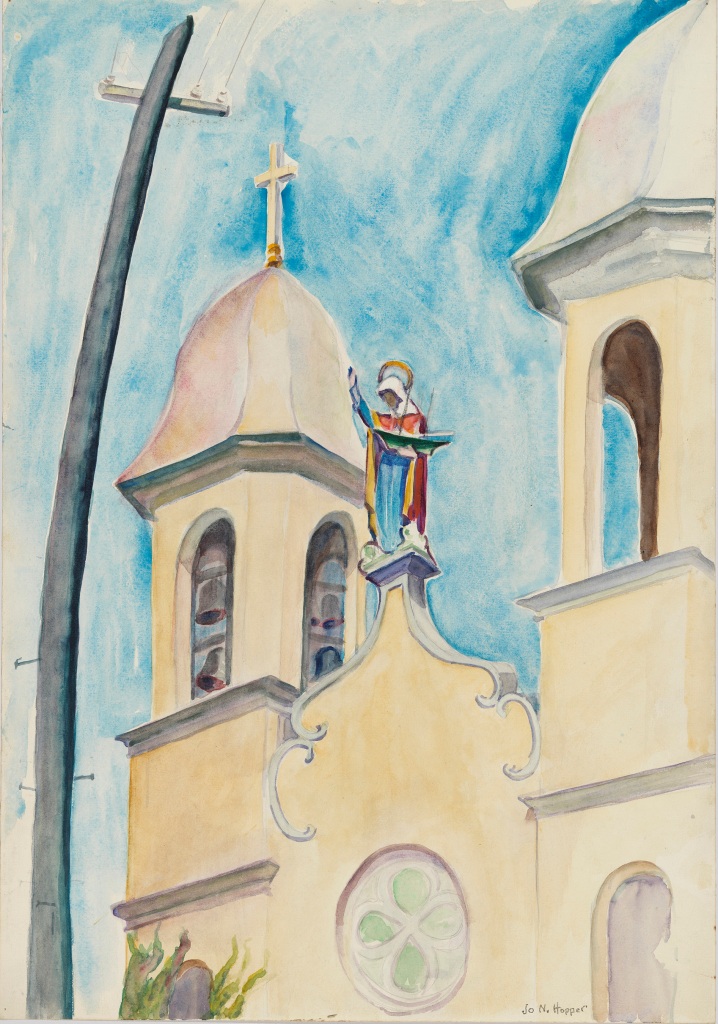
A few days ago I posted a review of the Hopper exhibit at the Cape Ann Museum in Gloucester, Mass., in which I described a painting by his wife, Jo N. Hopper, while admitting regret that I could not find it on-line.
Kind thanks to my friend, Tom Febonio of Rockport, a quaint fishing village right there at the tip of Cape Ann with Gloucester, who found it in a review of the exhibit by the Washington Post:
What fascinates here is the bend of the telephone pole toward the cross, as if drawn by a magnet, and the readiness of the Madonna’s outstretched hand to hold it up.
From a modern perspective, there may not be much more to say of it, but one century ago, Jo Hopper was looking at a brand new technology with an infrastructure that literally towered over the towers that congregations–that people–built to worship their God. When Europeans first settled in North America, most every village had a rule that nothing could be built anywhere nearly as high as a church steeple. Did Jo Hopper see an offer of collaboration or an imminent revolution? Was the hand raised in acceptance or resistance? And what of the identical T shape?
Since this is a much closer look at the church than was the painting I posted with the review, it’s worth noting the Spanish Revivalist architecture that we associate with the American Southwest and which, in this case, jolts many an unsuspecting New Englander visiting Gloucester for the first time.
Originally built in 1892 to serve a large Portuguese population that came to work in the local fisheries, it burned down in 1914, but was rebuilt by the 1920s when the Hoppers began spending summer vacations on Cape Ann.
The new church is nearly a replica of the Santa Maria Madalena church on one of the Azores islands from which most of the immigrants came. Our Lady of Good Voyage was added to the list of National Register of Historic Places in 1990.
-30-
Postscript: In addition to the fishing industry, many Azorean natives joined both the whaling and shipping industries, as Herman Melville tells us in a magazine piece from the 1850s titled “The ‘Gees” (with a hard G). Following descriptions that are mostly laudatory–including an unsurpassable work-ethic–and at other times reflective of the prejudices of Melville’s day, the summary line is more characteristic of Ishmael, his open-to-all and dismissive-of-none narrator of that novel he penned at about the same time:
’Gees are occasionally to be encountered in our seaports, but more particularly in Nantucket and New Bedford. But these ’Gees are not the ’Gees of Fogo. That is, they are no longer green ’Gees. They are sophisticated ’Gees, and hence liable to be taken for naturalized citizens badly sunburnt.
If you ever wondered how Kathy Bates would sound–or look–singing the Chiffon’s 1963 number one hit “He’s So Fine” with Maggie Smith on backup vocals, The Miracle Club is for you.
Young enough to be Smith’s great-grandaughter, Irish actor Agnes O’Casey do-lang-do-langs alongside her, a sight-gag with matching dresses. Before the last Oh, yeah, Laura Linney will join them–not behind the microphones but on a long bus ride from Dublin to Our Lady of Lourdes in the French Pyrenees.
As a quartet, they represent four generations, and with Dolly’s (O’Casey’s) young boy taken along for a cure, we could say five. This accounts for a tension barely noticeable at the start of Miracle Club that hits hard when Chrissie (Linney) returns from Boston after 40 years of silent absence to the row-house hood for her mother’s funeral.
As a film of re-generation, the mood and the pace of Miracle Club is comparable to other recent Irish and British films such as The Quiet Girl, The Duke, and Living.
Gradually we’ll learn that much is not what it seems, and that what links these women to each other is well in the past, present only in pictures on walls–or is it the future of the young boy looking into the snow globe he brought back to Dublin at the film’s end?
Rather than spoil it–or issue an alert–I’ll leave all that unexplained and say simply that, more than anything, Miracle Club is a film about reconciliation. For a capsule review, I cannot top Allan Hunter of Screendaily:
As the women set out on a journey each of them hopes will change their lives, along the way, old wounds are reopened, and the travelers are forced to confront their pasts. A quietly feminist film that honors the invisible labor of women, the complexities of motherhood, and the belief that change is possible.
In that, the “quietly” in front of “feminist” partly refers to the portrayal of three husbands left behind. There is one ugly moment and a few insults that in 1967, when this takes place, didn’t draw the offense they would now. The return to Dublin from Lourdes is another round of reconciliation, served as dessert after a full meal. Other than that, these scenes are played for comedy, especially the leak in the plumbing staged by Lily (Smith) for her getaway.
Call it comic relief from the traumatic revelations, accusations, and confessions we hear from the women in Lourdes. As the priest consoles a demoralized Eileen (Bates) when they leave, it’s not the cure that you look for, but the strength to go on when there is no cure.
In Lourdes, forced or not, the women relive their pasts. While miracles fail to occur, reconciliation beckons–or “peace” to use Chrissie’s word. That’s the Miracle in The Miracle Club.
-30-
Playing at the Screening Room in Newburyport now through Thursday, October 5 @ 4:30 each day:
When New Englanders say The Cape, it’s always understood to mean that imposing arm of a sandbar that flexes its bicep in the Atlantic and shakes a clenched fist at the Old World.
Those of us who live north of Boston are fine with that, as we play host to enough tourists who know of the beaches, the promontories, the lighthouses, the docks, the harbors, the woodlands, the trails, the fishing villages, the clam shacks, the orchards, the farmland, the castles, the theater troupes, the dance companies, the music ensembles of Massachusetts’ Other Cape that reaches from the coast like a hand open to all.
Cape Ann Pasture, Edward Hopper
While many artists have captured the beauty of Cape Cod on canvas, it’s hard to imagine that any have so thoroughly and repeatedly brought it to life as Edward Hopper (1882-1967) has done with Cape Ann.
May be hard to think of the creator of Nighthawks as a landscape (or seascape) painter, but the proof is on exhibit now through Oct.16 at the Cape Ann Museum in Gloucester, a thriving fishing port that Hopper and his wife, fellow painter, frequent model, and life-long muse, Jo Nivison Hopper, frequently visited in the Roaring 20s.
Any scape is equally misleading for an exhibit with so many paintings of buildings, featuring architecture as diverse as the dual towers of the Portuguese church and the mansard roof of the home of a wealthy merchant.
The Mansard Roof, Edward Hopper
But the overall impression is not so much of wood and bricks, boats and railroad cars, streets and water, or even trees and rock, harbor and surf.
All those subjects are on canvas, making the exhibit well worth the view. But Edward Hopper & Cape Ann: Illuminating an American Landscape is most memorable for the lighting in which we see the buildings and boats. Hopper was the artist, but Cape Ann is the star of the show.
House by ‘Squam River, Gloucester, Edward Hopper
Tempting to say the show was stolen by Jo N. Hopper as she signed her name to the ten or so canvases the filled a middle area surrounded by her husband’s work. A telephone pole curving toward the church steeple strikes me as an essay I dare not write, although a few draughts of Fisherman’s Ale at Blackburn’s Tavern may change my mind.
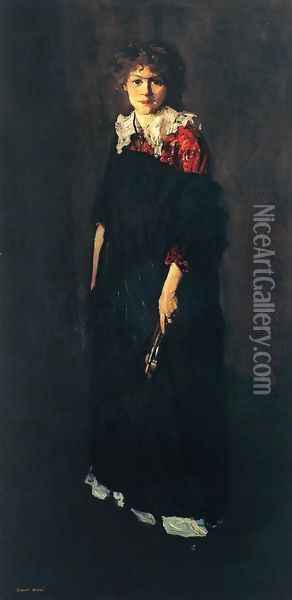
Her husband’s portrait of her is memorable for the ingenious angle at which he took it, and her self-portrait well past middle-age fascinates us with an inevitable comparison to another of her as a teenager. Called The Art Student, this was by Robert Henri who taught at the art school where Josephine Nivison and Edward Hopper met. According to the paragraph on the wall, she appears as “a little human question mark.”
But there’s no question over how either painter regarded Cape Ann. Every canvas is a statement, an offer made by an open hand.
No photos allowed at the Cape Ann Museum, and Jo N’s painting of Our Lady of Good Voyage with the telephone pole leaning toward it is nowhere to be found on-line. (If you can, please let me know,) Here’s one she did of the Portuguese church from another angle.
Prior to Cape Ann Museum, the only Hopper I had seen up close was Nighthawks at the Institute of Art in Chicago in 2008. Photo by Michael Boer: https://www.flickr.com/people/onewe/A painting by British painter Phil Lockwood (born 1941) in which every window is Edward Hopper’s painting, even the bar-cafeteria is a Hopper.
Yes, I’ve joined the cast of Salem’s Cry Innocent, but I’m tempted to plead Rye Guilty.
As kids, every American hears of Salem’s witch trials, and every October reminds us of them in living black and orange. An official holiday or not, Halloween is Salem’s night to moonshine.
Missing here is why. We know what: An estimated 150 people were imprisoned for witchcraft. At least 19 adults, most of them women, were executed—though we rarely hear of the two dogs also put down.
In lieu of any scientific reasons, all of the hallucinations, the convulsions, “St. Anthony’s Dance,” the skin lesions, the screaming and erratic behavior are attributed to the devil.
I’d say all of the mischief as well, but one theory holds that a Rev. Parris pushed some accusations to acquire vacated land. Another emphasizes the panic caused by a smallpox epidemic. Both, however, may be called pretexts for exploiting or misinterpreting teenage girls acting, looking, and sounding abnormal, often with menace.
For nearly three centuries, no scientific reason was offered until 1976 when a doctoral student at Renssalaer Polytechnic Institute noticed that similar outbreaks occurred earlier in various parts of Europe, all of them with identical symptoms suffered mostly by young girls. What these regions had in common were crops of rye, a grain then far more common to diets, and exceedingly wet seasons prior to the outbreak.
That sent Linnda Caporael, who would complete her doctorate at RPI, into the diaries of Salem villager Samuel Sewall who noted a wet, warm spring of 1691 followed by a hot, stormy summer.
Though it went unnoticed through most of the 18th Century, the excess moisture caused the growth of ergots—small, purple bulbs—on rye grain. Farmers likely thought nothing of it, may not have even noticed it, as they harvested and later milled the crop. According to the Encyclopedia Britannica’s website:
Since medical knowledge was sparse, the presence of darker shoots on rye was probably thought to be the product of overexposure to the sun.
Not only is it toxic, but hallucinogenic. The young girls, with their not-yet-fully-developed immune systems, started acting out late in 1691, and the hysteria was in full swing by year’s end. Almost all of these cases, Caporael found, were on the west side of Salem Village, where there was considerable marsh compared to the rocky east side. Whereas rye was a “common crop,” harvested by and for the immediate community rather than individuals, this fit her theory. Most of the hearings and trials were held in 1692, coming to an abrupt end, Britannica tells us, “quite simply because Salem ran out of ergot-contaminated grain.”
Caporael’s finding has been rejected by some historians who point out that, even in the 17th century, midwives knew how to harness ergot for inducing labor. Says one:
(T)he visions seem to come and go with the afflicted in ways that are more controlled than a hallucination would cause… [E]rgotism leads to gangrene and there is no documentation of the accusers having gangrenous limbs–even while other symptoms (admittedly similar…) are written about with detail.
Since ergotism was unknown at the time, Cry Innocent has nothing to do with it. So I’m well offstage and away from the cast when I ask: Does an outbreak in one place have to duplicate every symptom in another to be considered the same, or even related? As Britannica tells us:
With the exception of a few events likely triggered by groupthink and the power of suggestion, behavior exhibited in 1692 fits the bill of rye-induced ergotism…
Perhaps it was ergotism that triggered the groupthink and manipulation. Perhaps an American strain lighter than that which produced gangrene in Europe. As always, when you mix history and science you get theory, never to be 100% pinned down and always ripe for debate.
No doubt due to the immediate opposition in 1976, Caporael’s report was not widely circulated. There may have been public resistance as well. After all, as any child will tell you—and as any actor or director will quickly agree—villains are the highlight of any story. Satan versus ergot bulbs on rye grain? No contest!
Be that as may, count me as among those who espouse the theory. To a child of the Sixties, the hallucinatory properties seem close enough, and it is more than glaring that no explanation other than Satan has ever been offered.
The tide turned in October of 2012 when Discover Magazine published an essay comparing Salem’s trials to the Vardo trials in northern Norway throughout the 17th Century:
Hundreds of women were accused, and 92 burned at the stake for the crime of witchcraft. Ergot poisoning has also been suspected in several “dancing mania” events in Europe, in which masses of people danced randomly in the street for hours.
Two months later, Live Science offered an irresistible parallel to account for Santa’s annual trips around the world: Hallucinogenic mushrooms in northern Finland, a place with very few people, but many of them shepherds. About as close to the North Pole as you can get, this is where the reindeer, if not the antelope, play. After bites of mushrooms, shephards saw them fly.
Another character we think of as myth, is actually based on a historical figure. According to one of a handful of theories, he used laced bread to entice children to leave a Saxon village in 1284. If true, then for the Pied Piper—my ancestor so to speak—the music was more analogous to taking loaves from the oven than to the baking of the hallucinogenic bread he fed those kids. His flute served as an aural oven mitt.
Medical News Today could have had him in mind when it reported that LSD “is not the same as ergot fungus but contains some similar compounds.” The magazine did include the Salem trials in an extended diagnosis last year, offsetting the poison with a report of extracts with medicinal value for migraines and childbirth–as well as current research for Parkinson’s and Alzheimer’s.
Even Bon Appetit served up Salem’s contaminated rye, though it should have changed its name to Mal Appetit. One wonders if they were using the story to steer us toward French baguettes.
As for me, my sandwiches between performances will still be on dark rye. After the summer we’ve had, it may be all I need to stay in character.
-30-
Note: Nearly two years after writing this, I chanced upon a 1991 book titled Poisons of the Past by Mary Kilbourne Matossian who explains that ergotism has two strains: gangrenous and convulsive. That Salem’s young girls had no gangrene, therefore, does not rule out that they were afflicted by the latter strain. See: https://yalebooks.yale.edu/book/9780300051216/poisons-of-the-past/
Possibly the most quoted song of all the Sixties classics, it is the target of ridicule in a supermarket where I make my rounds today. Joni booms from the ceiling speakers as I walk in:
They’ve paved paradise and put up a parking lot! Ooooooooooh, ya, ya, ya…
One young deli clerk’s smirking laugh nearly makes his wisecrack redundant: “So, if we don’t pave paradise, where are we supposed to park our cars? Up in trees?”
He appears to be answering someone in a back room, and I do not catch the remark that prompts or follows his car-wrecktorical questions. Indeed, I have no idea If I’m hearing one side of a debate or one half of unanimous condemnation.
Before I can learn which, the clerk is summoned away, leaving me no chance to put my quarter–or my credit card as today’s well-paved world now has it–into any meter of Joni Mitchell’s “Big Yellow Taxi.”
Just as well. The comment is so unprecedented, at least to me, that I’m at a loss for words. There’s a reason that it’s been among most quoted musical lines for over fifty years and counting. Just last month, I headlined a blog, “Of Paradise & Parking Lots,” and last week it appeared in my Newburyport Daily News column, “Best-Sellers R Us,” as a metaphor for the recent, indiscriminate, hi-tech-driven practice of “weeding” in public libraries.
At the deli counter today I feel as if I’m hearing JFK’s “Ask what you can do” singed in the cynicism of “what’s in it for me?” There’s no question that the Zeitgeist of the Sixties–from Joni to JFK, or from Kerouac to MLK–seems quaint to those in the thrall of America’s Algorithms-Über-Alles 21st Century, but Joni’s “birds and bees”? Please!
Half a century later, our modern day technocrats keep putting up parking lots without gloating over the loss of paradise, or claiming that those of us wanting to preserve it are a bunch of losers. Rather, they merely insist, no matter the evidence to the contrary, that the more parking lots, the better.
By now, they may be right. When Mitchell wrote that song, shopping malls were a new concept. Up until then, most shopping for clothes, hardware, and household items was done downtown in city or town centers. Groceries were purchased at corner stores in most neighborhoods where you also found barber shops, pizza shops, and fish markets. Most all businesses were owned and run by families who lived in the town; what they spent, they spent in the town. In effect, all of us spent what we spent on each other on each other.
That was the America in which Mitchell, a Canadian, arrived only to see us chain ourselves–in both senses of the word–to shopping malls. They were promoted as convenient under the banner of “one-stop shopping,” and it was easy for the corporate owners in New York, Chicago, Los Angeles, Tokyo, or anywhere else with skyscrapers to undersell the mom-and-pops downtown and around the corner.
In the winter, there was the added advantage of remaining indoors as you went from store to store. To make it even more inviting, mall designers placed a few chairs in the corridors, and, as my slightly older cousin enthused at the time, “had music coming out of the ceilings” while she and her girlfriends strolled those corridors in a time-honored ritual now facilitated by a controlled environment.
Because so many stores expected so many customers, and because they were all being built on outskirts of towns and cities, massive parking lots were required. No more walking to get a haircut or a pizza or fish-n-chips. No more bus rides downtown.
Often, these were open fields where kids played games, woods with trails where kids went exploring, parks where people of all ages walked, sat, picnicked, romanced, meditated, dreamt, thought long thoughts, asked what they might do for…
This is what Joni Mitchell saw paved.
Not sure if it’s even possible to communicate that to a teenaged deli clerk today. I doubt that such variables would fit any app on his cellphone, nor do I think he’d ever give up the option of one-stop-shopping for a return to mom-and-pop businesses any more than would his parents or his parents’ generation. And, so, yes, he–they, we–must have ample parking.
“Big Yellow Taxi” was a huge, instant hit playing all over the radio, AM and FM, when I was a teenage clerk in a downtown delicatessen. I loved it as much as anyone, especially the line more than one female friend at Salem State liked to sing from time to time:
You don’t know what you got till it’s gone…
Chances are they had in mind the loss of doomed relationships rather than the loss of Mother Nature to concrete and asphalt, but I was so vain, I never thought they sang about me.
That may be why I shouldn’t fault the deli clerk I heard today for laughing at it. The last laugh, after all, is his. Delicatessens such as where I worked were pretty much erased by the supermarkets such as where he works. All made possible by a few football fields’ worth of pavement.
I’m the only person I know who was once hired because the guy choosing from the applications noticed that my birthday, March 18, matched his.
Turned out that the place of employment and the job itself were just as loose, to put it in the parlance of the 1970s. My job was to place large colorful numerals on enormous pieces of just as colorful nylon that, when stitched together, would form spinnakers, or racing sails.
Not the triangular sails that you commonly see on all sailboats, but those huge, billowy, and perfectly symmetrical sails on boats that compete for world cups. Fifty years ago, Ted Hood of Marblehead, Mass., was an annual contender for and at times winner of those cups. Among his advantages was his own sail making company that made them to exact specifications.
Spinnakers are so large that we worked on a floor kept cleaner than the tables of our own college dorms and apartments back in Salem. Knee pads made it easy, as did a rock-and-roll station that played non-stop. Then came the breaks every two hours during which the guy with my birthday would lead his team, all eight of us, out of the building and onto a smooth rock overlooking the ocean to enjoy the sea-breeze and a bit of spray if the surf was up.
Once we were seated and sipping our coffee or soda, he’d reach into his pockets, find a joint, already rolled, strike a match, get it going, and then pass it along. By the time the third person had it, he find another, light it, and pass it on. No one was obliged to partake, though I think we all did. I certainly don’t recall checking a yes or no for marijuana use on the application, but he may have assumed it of a fellow Pisces.
You’re not going to believe this, and even though pot is now legal, it’s probably very bad manners or grossly politically incorrect to say it, but here goes: Our work was easier once we were high. This may be due to so many bright colors being combined, a heightened sense that these were works of art that we weren’t just making, but making possible.
Back in that day of altered consciousness, we’d experienced what we called a “rush,” that might be described as a moment of ecstacy or enlightenment. At Hood Sail this happened whenever the radio station reached back six or so years and played the unmistakable strumming of an autoharp to open a Lovin’ Spoonful song.
Everyone stopped. The women at the machines, the people at the tables, the supervisors in their tracks all looked up as if the band was there attached to the wall in place of the speakers. They all smiled, nodded to each other, and returned to work. I doubt that any of those folk were getting high. First time we, the summer crew noticed this palpable adoration, we must have looked confused. My birthday boss (and drug supplier) noticed:
“He worked here!”
“Who worked here?”
“John Sebastian! The guy singing that song, a song he wrote. He had your job!”
Guess I missed him by at least ten years. I was still in high school when I attended two Spoonful concerts. At one, at my high school–a Catholic high school!–I met and was hopelessly smitten by Donna, an attractive lass who claimed to be drummer Joe Butler’s cousin. But she arrived on a bus from Winnacunnet High, some 30 miles distant, and these were my learner’s permit days before I could drive in the night when, as Sebastian sang, “it’s a different world.”
The Spoonful’s reputation as a folk-rock band was misleading. Sure, Sebastian looked angelic in his granny glasses and picking his autoharp, but they often launched into instrumental riffs led by guitarist Zal Yanovsky that were as kick-ass as what the Beatles and Rolling Stones were putting on albums. To describe it with other common 70s’ expressions, they cooked, they sizzled.
“Do You Believe in Magic?” and “Did You Ever Have to Make up Your Mind?” were my favorites back then, although “Summer in the City” and “Rain on the Roof” have more appeal now. Whichever you pick, “Bald Headed Lena” included, it is one of the crying shames of rock music history that John Sebastian is today remembered more for a televison sitcom’s theme song than for all those great Spoonful hits.* What a day for a…
…Daydream
You Didn’t Have to Be So Nice
Nashville Cats
Darlin’ Be Home Soon
Bald Headed Lena…
…has anybody seen her? Cute as she can be/ She don’t wear no wig ’cause her head’s too big/ But she’s alright with me…
Well, who am I to complain? I recall him more for the best summer job with the most unlikely fringe benefit I’ve ever had. All because my supervisor’s birthday is the day after his.
About twenty years after all that, or thirty years ago, my daughter, then about 15, and I were travelling through Ontario when we put in for the night at a bed and breakfast in Kingston, a very attractive, elegant small city at the east end of Lake Ontario where you can take tours on boats that zig and zag from the lake into the beginning of the St. Lawrence Seaway.
On a table in the lobby were about a dozen menus of downtown restaurants, all within walking distance. I asked Rachel to pick one while I moved luggage into the room. She handed me one for a place she clearly chose for it’s name, Chez Piggy, but I was immediately struck by the name of one of the two proprietors in the top righthand corner:
Zal Yanovsky.
So in character! The restaurant’s goofy name and equally goofy logo of a smiling oinker… It had to be the guy who gave Sebastian a rest by singing lead on “Bald Headed Lena.” Off we went on that mild summer evening to a gorgeous, quaint place with outdoor seating. As soon as we were seated and I ordered a pint of ale, I asked the waiter.
“Oh, yes! And if you arrived just ten minutes ago, you could have shaken his hand.”
In time, I’d learn he was a native of Toronto where he busked Yonge Street with Dennis Doherty before they struck out for fame–Doherty to LA where he joined the Mamas and the Papas, Yanovsky to NYC where he met Sebastian. A fellow busker! The meal, by the way, was delicious, as was the Sleeman Ale.
Occurs to me, as it might to you, that my last blog was about missing Jimmy Buffett when I moved into a South Dakota trailer court about five years after he left. That, as you might guess, was what reminded me of missing John Sebastian by ten years and missing Zal Yanovsky by ten minutes.
Is it merely coincidence or cosmic consolation that the settings for both–a summer job, a restaurant far from home–were as good as it gets?
*For more about the Lovin’ Spoonful–how they came together, stayed together, and came (abruptly) apart, see bassist Steve Boone’s 2014 memoir, Hotter than a Matchhead, a title taken from the hit song, “Summer in the City.” Some wild surprises, such as their employment as the Beatles’ roadies for the gig at Shea Stadium and driving around Manhattan in an old, beat up station wagon belonging to Bob Dylan who insisted on driving while lighting and passing around joints:
So Jimmy Buffet lived for a couple years in Brookings, South Dakota. In a trailer court. Can you guess who else once lived a Brookings trailer court?
To this day I can barely explain how I–a Massachusetts boy always called a “Boston boy” because my state’s name ties western tongues–ever landed in that small college town hard by the Minnesota border.
How a native of Mississippi who grew up on the shores of the Gulf of Mexico landed there is beyond me. How I never heard mention of him after my arrival just six years after he left–two years after the release of “Come Monday” and just months before the release of “Margaritaville”–compounds the puzzle.
At a dead end of my own youthful indirection, if not indiscretion, I was tempted by a classified ad in Editor & Publisher, a trade magazine. Attending South Dakota State University’s graduate school of journalism was the pretext, but the real draw was moving someplace where no one knew me and vice versa.
Compare that Buffett’s description of his move in his 1998 memoir, A Pirate Looks at Fifty (a title that plays on his own song, “A Pirate Looks at Forty”):
The Great Plains looked like as good a place as any to get lost in for a while… The next thing I knew, I was headlining Steak ‘n’ Ale joints all over the Midwest, making five hundred bucks a week, with a free salad bar. At first I loved the wide-open spaces, but one afternoon in a trailer park in Brookings, South Dakota, where I was living, the siren in town sounded a tornado warning. Across the flat, open field to the west came not one but two twisters. I, of course, had been in storms at sea, but this was different.
In the 1970s, $500 bought much more in South Dakota than back here in Massachusetts. Add that adjustment to fifty years of inflation, not to mention all those salad bars, and it’s no surprise that Buffett could sing that he “made enough money to buy Miami.”
On the prairie where towns are tiny and spread out, “Steak ‘n’ Ale joints” tend to be quite large with vast parking lots that fill up on weekend nights with cars carrying in people from miles around. Brookings is a full hour north of Sioux Falls, the biggest city in the Dakotas–as well as in neighboring Wyoming and Montana with Idaho to boot. Barely the size of Providence now, Sioux Falls was more the size of Pawtucket then. Many other towns are under 5,000 population, some of them but crossroads.
According to a 2008 report from my SDSU friend Tom Lawrence, now co-editor of The South Dakota Standard, Buffett was immensely popular throughout the region. Lawrence interviewed the owner of Jim’s Tap, a Brookings bar, and a chef at a local supper club who agreed, as the latter put it, that Buffett “did a good job of packing the house.”
Considering that Jim’s was a favorite watering hole of mine in the Carter years, it’s all the more puzzling that I never heard of Buffett in Brookings.
Buffett enjoyed his time in Dakota. Enough so that when Lawrence was sent to cover a concert in Texas, Buffet took him past security and backstage as soon as my friend blurted out his one allotted (by an “unctuous” security guard) question at a distance: “Did you live in South Dakota?”
Lawrence describes Buffett’s dawning smile of recognition as if it was that of a man who just found that lost shaker of salt. Thankfully, the interview is more of a gold mine than a salt mine, and I’ll add the link below.* But not before I chip away at a nugget as galling as it is satisfying to consider:
In Brookings, Buffett lived in a trailer court. If I was wide-eyed when I saw Brookings in the tributes, I was dropped-jawed by this. Trailer court I lived in was on the western edge of town overlooking alfalfa fields that went on forever. Just eight trailers where we all knew each other and often sat together drinking and smoking weed outside.
My then-neighbor and still-friend Bruce dubbed it the “Easy Livin’ Trailer Court,” a name that stuck. Would have been perfect for a singer-songwriter with a laid-back vibe. Had he stayed anywhere in South Dakota, his fans would be known as “Pheasantheads.”
While there’s no question that his music was escapist, Margaritaville a place to be “wasted away again,” Buffett was as aware as any artist of art’s environment. Come any day of the week in the mid-70s, and you’d hear people sing “in a brown LA haze” when residents of many American cities were living in grayish brown and orange clouds, when papers such as the Denver Post put air quality warnings on their front pages every day. The EPA, brand new at the time, had a mandate of public support that “Come Monday” likely helped galvanize. Those clouds were gone by the mid-80s.
No wonder Buffett was alarmed by the view from his trailer of tornadoes touching down on a “flat, open field to the west.” Wish I could ask if it was an alfalfa field he looked over.
Lawrence reminds me that Brookings, a college town after all, has several trailer courts, all of them much larger. By the time I arrived, Buffett was already in California growing into his beach bum persona. By the time I left, perhaps I was chasing him in some unknowing way.
Where did I wash ashore? Plum Island, and I’ve been here ever since, spending as much or more time on a beach all these years as anyone, provided you do not count the winter months.
Buffett, meanwhile, strolled the beaches of Key West, Florida, where there are no winter months. And where the risk of skin cancer must be high. I was probably spared his fate in 1998 when a dermatologist insisted on removing a spot as soon as he saw it, my plans for boiled shrimp and sponge cake be damned.
Some people claim that there’s carelessness to blame. Yes, as Buffett ended his most beloved song, “I know it was my own damn fault.”
One of the advantages of workouts at the gym is the view you have of television monitors that line the wall where it meets the ceiling.
A sports fan can keep an eye on three or four games at a time. For a news junkie, there’s CNN, CBS, and NBC. For those who need to feed their fear, paranoia, and prejudices, or who just want a free lobotomy, there’s Fox (so-called) News.
Of course, you can’t hear any of them, which is a blessing in that last case, but most have crawls that my septuagenarian eyes can read from the treadmills three rows back.
Since I joined in January, I’ve been reading on the news stations of severe weather caused by climate change, of attempts to repeal reproductive rights, and of investigations and indictments resulting from an attempt to overthrow an election.
On Fox, of course, it’s all about the president’s son’s questionable business dealings, crime rates in cities, “chaos” at the southern border, and inflation.
There is one story the stations have in common, but according to the crawls, they appear to be quite different. On the news stations, it’s about attempts to censor books in school curricula and libraries, threatening teachers and, yes, even librarians with criminal charges. On Fox, it’s all about “violations” of “parental rights” each time censorship is ruled unconstitutional.
Makes you wonder if the First Amendment protects calls to hang the vice-president but not To Kill a Mockingbird–and if a gallows with a noose at the ready on Capitol grounds is patriotic while a rainbow flag hung from a front porch is anti-American.
Tempting to say that the broadcasts seem to be of different worlds, but all news stations have covered Hunter Biden’s legal problems, including his guilty plea. They also cover news from cities and from the Rio Grande. Unlike Fox, they let us know that crime rates are way down, as is illegal immigration.
Inflation? We may be paying more for food, but folks growing it, harvesting it, picking it, preparing it, packaging it, transporting it, cooking it, serving it, and washing the plates and bowls and pans and containers in which it comes to us are making more and are able to afford more. To them, the last two years have made the difference between what we euphemize as “food insecurity” and what we proudly hail as a “living wage.” What kind of people would erase that for the sake of a favorite cheese returning from the $5.49 a block it is now to the $4.99 it was two years ago?
Unlike Fox, real news outlets also report how unemployment is now at its lowest rate since the 1960s, that wages are up, and that factories have been and continue to be built as a result of the CHIPS & Science Act, an initiative of the Biden Administration signed into law a year ago this month.
CHIPS (Creating Helpful Incentives to Produce Semiconductors) is never mentioned on the crawls of Fox. Nor do those crawls say anything of numerous Republican representatives and senators now taking credit for its benefits in their districts–even though every one of them voted against it.
Republicans did the same 13 years ago when Obamacare was passed–taking credit for the benefits after voting against it en mass. But that was long before I joined a gym, so I don’t know how Fox distorted Republican double-talk or if they just ignored it. Like many of my friends, I have over the years made attempts to watch Fox for the sake of understanding it. And, again like friends, I can hold my breath underwater for longer than I can inhale that station’s unrelenting rage. That they mask so much of it as insinuating questions–thereby dodging accountability–just makes it worse.
Fox has been held to account in court. For documented lies about Dominion voting machines, Fox forked out a settlement of $787.5 million. In the world of an “informed citizenry” imagined by Jefferson and Madison, that would be more than enough to put an end to Fox. But when enough of the citizenry depends on Fox to be informed, all the station needs to do is keep the lawsuit off the air. Eventually, the money from advertisements will cover the costs of all guilt–no matter how high the costs or deep the guilt.
As historian Howard Zinn pointed out, the deception is not so much in lies as in emphasis and omission.
Which is why the price of gas is now a dangerous issue. Despite all appearances, gas is not a dependable gauge of inflation. Often, it’s a gauge of corporate greed, as we learn every time Exxon, Mobil, Shell and other companies report record profits as if they are unrelated to the increases at the pump. Also, like the prices of cigarettes and postage stamps, that of gas is subject to geo-political whims and pressures. That’s why it sometimes goes back down.
We’ve all noticed it creeping back up in recent weeks. Those who read the news–from actual, credible sources–know that this is a result of a deal between Russia and Saudi Arabia to squeeze the supply and put pressure on us. Their goal is to keep raising the price to over $5 per gallon next summer when Republicans can ride it as a campaign issue.
Putin wants Trump back in the White House to undo the NATO alliance and let Russia have Ukraine. The Saudi Prince wants Trump back in charge so he can cash in on a loan to son-in-law Jared Kushner so large that it makes Hunter’s laptop look like the shoebox cash register at a child’s lemonade stand.
None of this appears in Fox crawls. Judging from the crawl’s constant attachment of the name Biden to the word inflation–under a barrage of pictures showing signs of prices at gas stations–it’s a safe bet that Fox hosts never talk about it.
Instead, they will emphasize the rising cost while omitting the reason for it. Call it the gas of price.
Their audience will not just believe it, but will grieve about it, loudly and frequently. Problem is that many who don’t watch Fox don’t pay much attention to other sources either. Too many of us won’t hear of higher employment rates if already employed, or of higher wages if working at places where rates are locked in. But the signs will be up at every gas station where the numbers roll up at the pumps.
Only way to counter this is to not let the claim slide.
May be uncomfortable in a group of people you barely know, or at the proverbial holiday dinner table, but there’s no need to attack anyone, any political party, or any bogus news source. No need to raise a voice or argue at all. All we need do is state the reason for the increase in gas prices–and offset complaints of inflation with talk of employment rates, higher wages, and new factories as they appear across the country.
In a word, provide and emphasize what the gas of price omits. Much the way the numbers on a treadmill–distance, time, calories–provide real numbers that all those television monitors tempt us to avoid.











 Mouth of the River